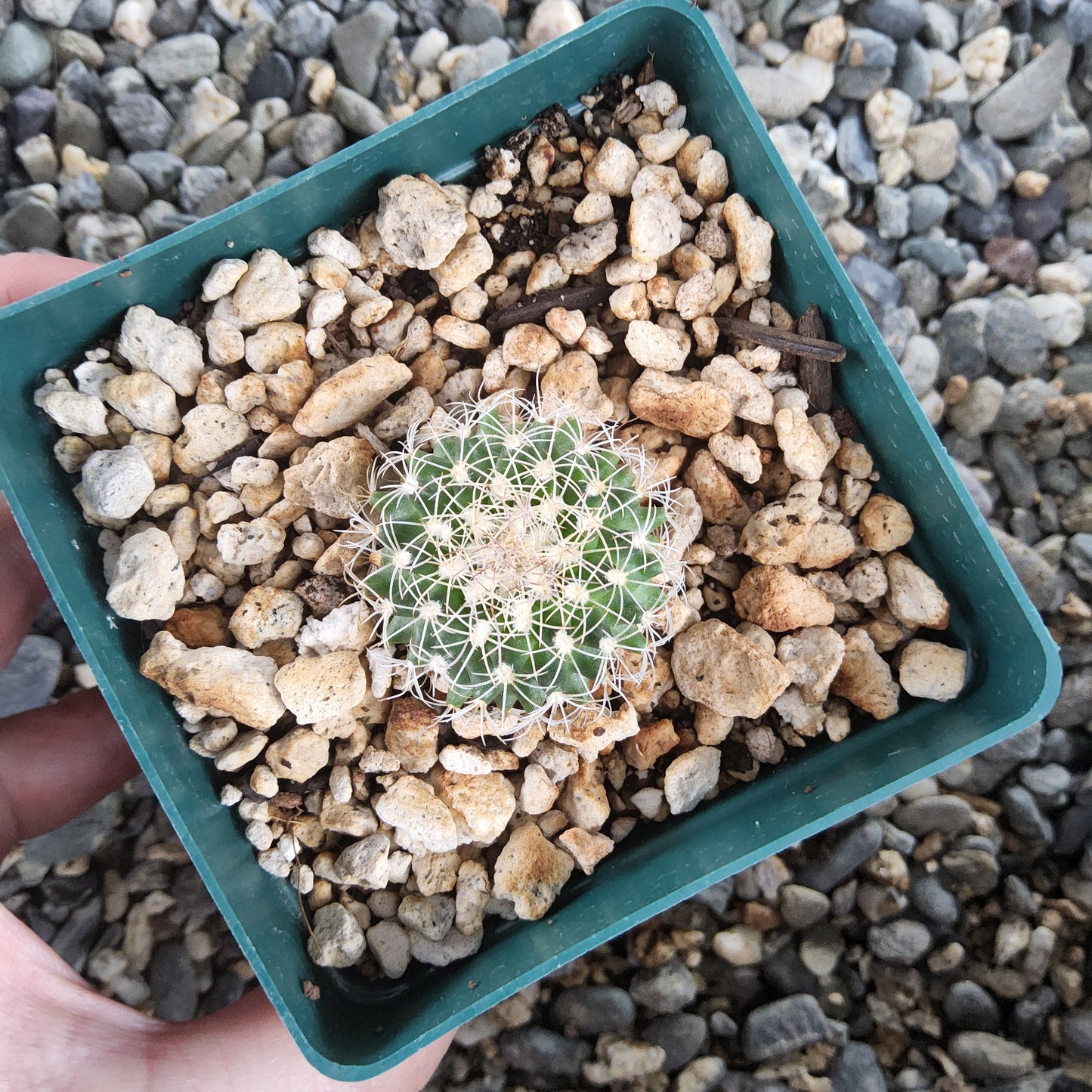
Turbinicarpus saueri ssp. gonzalezii PP1234 | Rancho Chapala, Tamaulipas, Mexico | Field-Numbered Collector Cactus Growing in 4 Inch
Turbinicarpus saueri ssp. gonzalezii PP1234 | Rancho Chapala, Tamaulipas, Mexico | Field-Numbered Collector Cactus Growing in 4 Inch
Couldn't load pickup availability
Turbinicarpus saueri ssp. gonzalezii PP1234 is a beautiful field-numbered collection representing a documented wild population from Rancho Chapala, Tamaulipas, Mexico. This distinctive subspecies is admired for its compact, often partially geophytic growth habit, neatly arranged tubercles, and refined radial spination that allows it to blend seamlessly into its rocky surroundings. During the flowering season, mature plants produce striking magenta blossoms that emerge from the crown, providing a vivid contrast against the pale body and delicate spines.
Like many members of the genus Turbinicarpus, this subspecies has evolved to survive in one of northeastern Mexico's most demanding environments. Its slow growth, compact form, and remarkable longevity make it an exceptional addition to any serious collection of Mexican miniature cacti.
Native Habitat:
The PP1234 accession is associated with Rancho Chapala, Tamaulipas, Mexico, near the border with Nuevo León. The subspecies grows in light-colored limestone clearings within dense Tamaulipan thorn scrub, where scattered openings provide abundant sunlight and excellent drainage. The surrounding vegetation includes seasonal grasses, Agave, and numerous drought-adapted shrubs, while associated cacti include Ariocarpus trigonus, Astrophytum asterias, Ancistrocactus megarhizus, and Mammillaria heyderi ssp. hemisphaerica. These plants are adapted to a strongly seasonal climate characterized by hot summers, periodic rainfall, and comparatively dry winters.
Flowering Information:
Mature plants flower from spring through early summer, producing beautiful magenta to deep pink flowers with a contrasting darker throat. Like other members of the cactus family (Cactaceae), the flowers are hermaphroditic, possessing both functional stamens and a pistil within each flower. Pollination is carried out primarily by native insects. Cross-pollination between genetically distinct plants is recommended for the best seed production and helps preserve the genetic diversity of cultivated collections.
Soil Type:
Grow in a sharply draining mineral substrate consisting primarily of pumice, coarse limestone gravel, decomposed limestone, coarse sand, and only a modest amount of organic material. Excellent drainage is essential throughout the year. Replicating the mineral-rich limestone soils of its native habitat encourages healthy root development and compact growth.
Hardiness:
Best suited to USDA Zones 8–10. Mature plants tolerate brief periods of light frost when kept completely dry, but prolonged freezing temperatures and cold, wet soil should be avoided. A cool, dry winter dormancy promotes compact growth, healthy roots, and dependable flowering.
Light Requirements:
Thrives in bright light with several hours of direct sun each day. Strong light encourages compact growth, healthy spine development, and abundant flowering. In extremely hot climates, light afternoon shade during the hottest part of the day may be beneficial while maintaining excellent air circulation.
Propagation:
Primarily propagated from seed, preserving the natural diversity found within this documented locality collection. Plants develop a well-formed taproot that should be accommodated with a deep, sharply draining container. Because this subspecies is typically solitary, vegetative propagation is uncommon. This species does not develop a true caudex; its enlarged taproot is a normal adaptation for water storage and survival in its native limestone habitat.
Collector's Note:
Turbinicarpus saueri ssp. gonzalezii was formally described by Pavel Pavlíček and Jiří Zatloukal in 2005 and is currently accepted by Plants of the World Online (Kew). The subspecies was named in honor of Miguel González-Botello, a Mexican botanist from Linares, Nuevo León, whose fieldwork led to the discovery of the population and whose herbarium specimen was designated as the nomenclatural type for the taxon.
The field designation PP1234 is associated with the Rancho Chapala locality in Tamaulipas.
This is for one plant similar to the one shown growing in a 4" inch container shipped bare root. All of our plants are guaranteed pest-free and healthy upon delivery, and we ship within the United States. Shipping is done Monday thru Friday.
Any questions please ask.
#prsucculents
Share