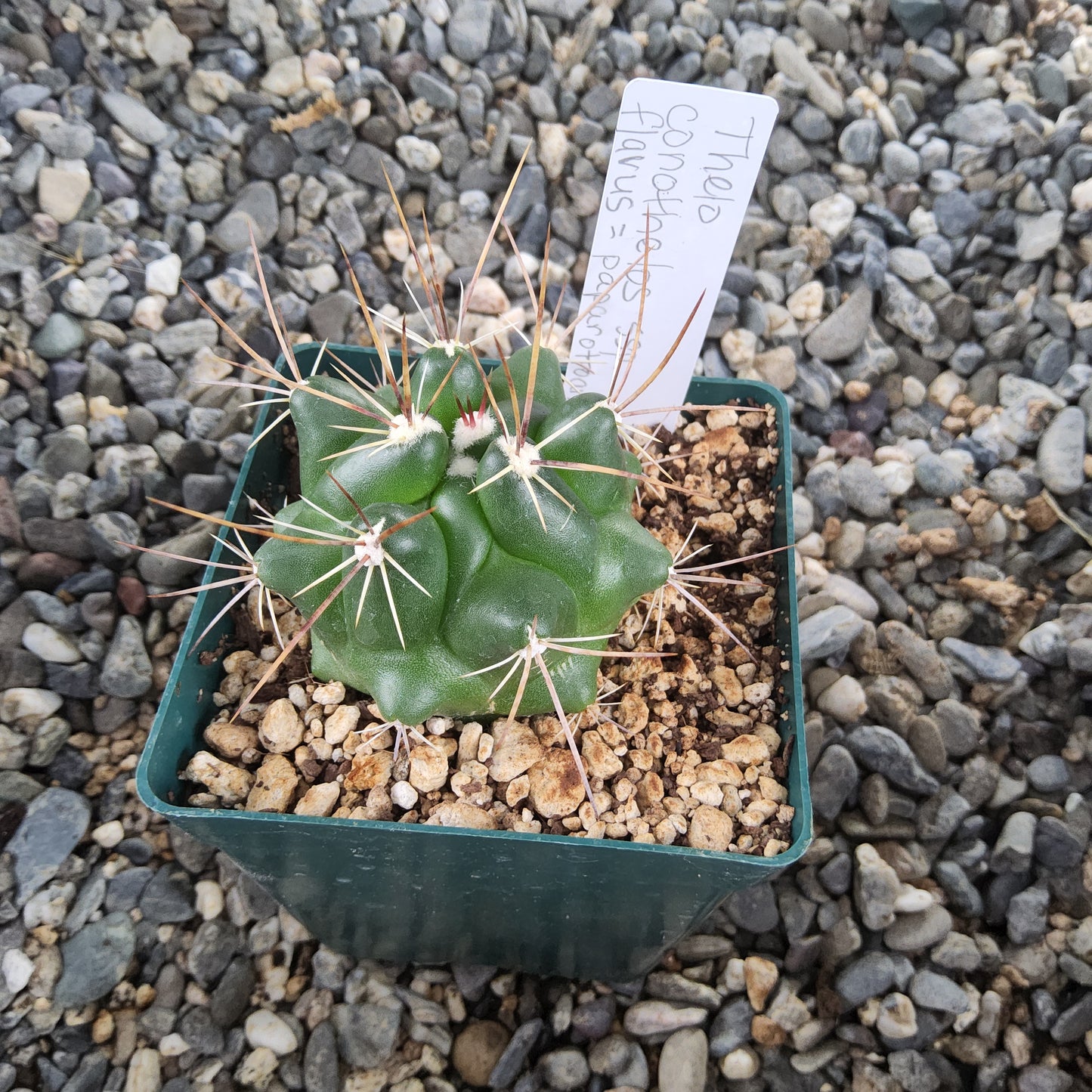
Thelocactus conothelos ssp. flavus | Yellow-Flowered San Luis Potosí Collector Cactus
Thelocactus conothelos ssp. flavus | Yellow-Flowered San Luis Potosí Collector Cactus
Couldn't load pickup availability
Thelocactus conothelos ssp. flavus is a distinctive yellow-flowered member of the Thelocactus conothelos complex from San Luis Potosí, Mexico. It is immediately recognizable by its strongly tuberculate olive-green to purplish body, long open spination, and brilliant clear-yellow flowers. Plants are usually solitary when young but may slowly branch from the base with age, eventually developing into attractive multiheaded specimens.
The ribs are completely divided into prominent conical tubercles arranged in spirals, giving the plant a strongly geometric appearance. Each areole carries several long, slender central and radial spines that range from ochre to gray and may reach impressive lengths on mature plants. This combination of exaggerated tubercles, long needle-like spines, and luminous yellow flowers makes ssp. flavus one of the most recognizable forms within the conothelos group.
Native Habitat:
Thelocactus conothelos ssp. flavus has a highly localized distribution in San Luis Potosí, occurring in a relatively small area between Entronque Huizache and La Hincada at approximately 1,200–1,600 meters (3,940–5,250 feet) elevation. Plants inhabit xerophytic scrub on rocky limestone hills within the southern portion of the Chihuahuan Desert, where shallow mineral soils, intense sunlight, seasonal rainfall, and rapid drainage create demanding growing conditions.
The broader Huizache region is one of the most cactus-rich landscapes known in North America, with approximately 75 native cactus species documented within the study area. Notable cacti and xerophytes recorded from this region include Ariocarpus bravoanus, Ariocarpus kotschoubeyanus, Ariocarpus retusus, Astrophytum myriostigma, Echinocactus horizonthalonius, Echinocactus platyacanthus, Leuchtenbergia principis, Lophophora williamsii, Epithelantha micromeris, and numerous species of Echinocereus, Ferocactus, and Mammillaria.
Flowering Information:
Mature plants flower primarily during spring, producing brilliant yellow flowers approximately 3–4.5 cm (1.2–1.8 inches) across. Both the anthers and stigma are yellow, creating a nearly uniform golden floral display that contrasts beautifully against the darker epidermis and grayish spines.
The flowers are hermaphroditic, containing functional stamens and a functional pistil. One particularly interesting feature of this group is the position of the primary stamens above the base of the floral receptacle, a characteristic that helped establish its relationship to the Thelocactus conothelos complex rather than to Thelocactus tulensis, with which these plants were historically confused.
Soil Type:
Grow in a sharply draining, predominantly mineral substrate composed of pumice, coarse limestone gravel, decomposed granite, coarse grit, and only a modest amount of organic material. Excellent drainage and strong root-zone aeration are essential.
Allow the substrate to dry thoroughly between waterings. Water moderately during active spring and summer growth, then reduce watering substantially as temperatures cool. Avoid prolonged moisture during winter.
Hardiness:
Best suited to approximately USDA Zones 9–11. Established plants can tolerate brief temperatures near 20°F (-7°C) when completely dry, but prolonged freezing temperatures and cold, wet soil should be avoided.
A cool, dry winter dormancy encourages compact growth, healthy roots, and reliable spring flowering.
Light Requirements:
Thrives in bright light to full sun. Strong illumination encourages compact growth, robust spination, and dependable flowering.
Plants grown under greenhouse conditions should be gradually acclimated before exposure to intense outdoor sunlight. In exceptionally hot climates, some light afternoon protection can reduce heat stress without compromising the plant's natural form.
Propagation:
Propagation is primarily from seed, which is the most dependable method for this taxon. Plants only rarely produce basal offsets, although older specimens may occasionally branch and form small clusters.
Seed-grown specimens display natural variation in spine length, body coloration, and growth habit and are preferred for maintaining the characteristics of this localized San Luis Potosí population.
Collector's Note:
The yellow-flowered plants now known as Thelocactus conothelos ssp. flavus circulated in cultivation for many years before their taxonomic identity was clarified. They were sometimes distributed under the unpublished name Thelocactus longispinus and were also confused with Thelocactus tulensis because of their long spines and superficially similar bodies. Detailed study of their flowers and seed morphology demonstrated that they belong instead to the Thelocactus conothelos complex.
Josef Halda described the same San Luis Potosí plant as Thelocactus panarottoanus in 1998. Alessandro Mosco and Carlo Zanovello independently described it as Thelocactus flavus in 1999, based on material associated with Huizache and collection HK 362, and subsequently published the combination Thelocactus conothelos ssp. flavus in 2000. At subspecies rank, flavus became the familiar name used by many collectors for the Huizache–La Hincada populations.
Kew's Plants of the World Online currently takes a broader taxonomic view and treats Thelocactus conothelos ssp. flavus, Thelocactus flavus, and Thelocactus panarottoanus as synonyms of the accepted Thelocactus conothelos ssp. aurantiacus. The name ssp. flavus nevertheless remains useful in horticulture because it identifies the geographically localized San Luis Potosí plants with their characteristic long spines and clear yellow flowers.
This is for one plant similar to the one shown growing in a 4" inch container shipped bare root. All of our plants are guaranteed pest-free and healthy upon delivery, and we ship within the United States. Shipping is done Monday thru Friday.
Any questions please ask.
#prsucculents
Share