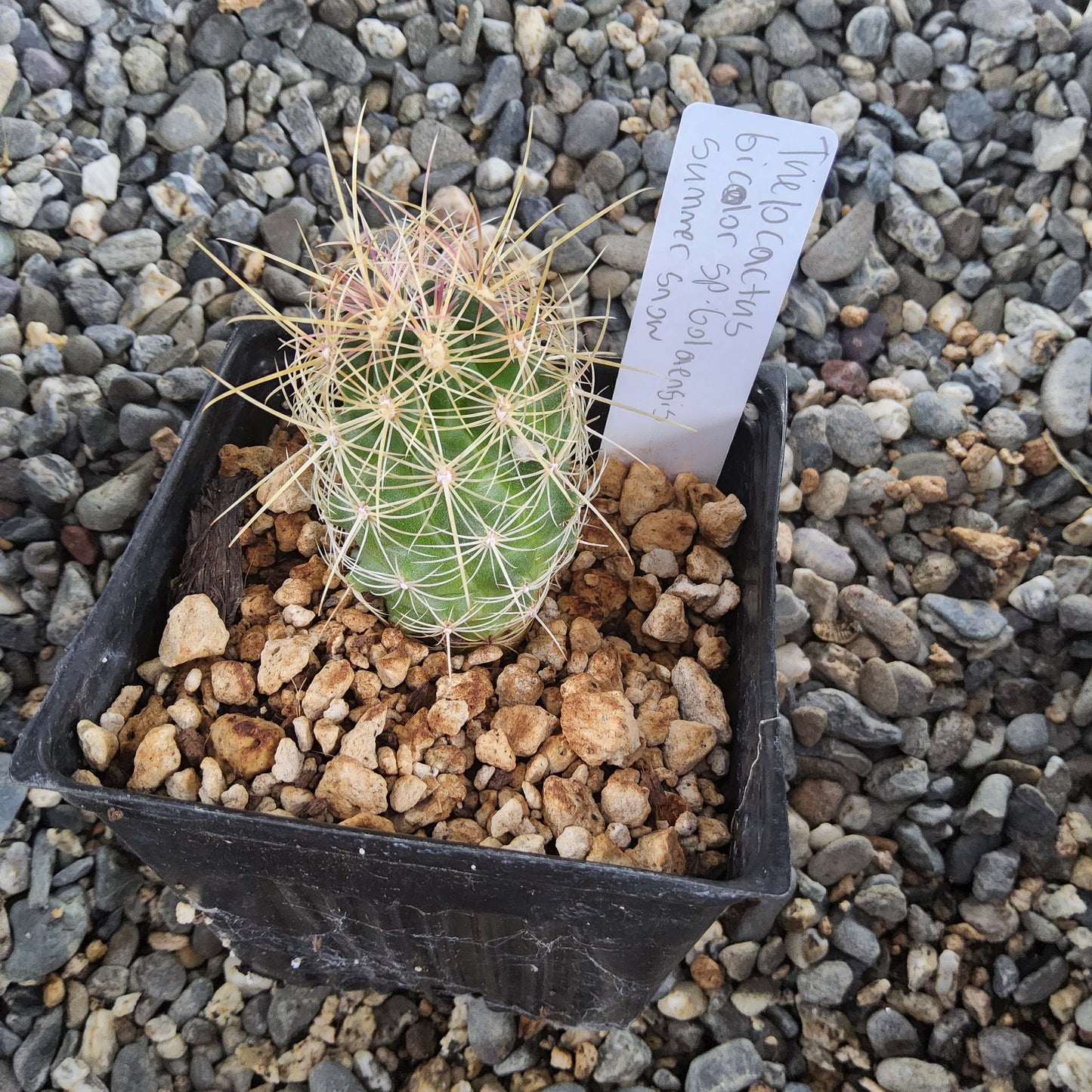
Thelocactus bicolor ssp. bolaensis 'Summer Snow' | White-Spined Coahuila Cactus | Collector Cactus Growing in 4 Inch
Thelocactus bicolor ssp. bolaensis 'Summer Snow' | White-Spined Coahuila Cactus | Collector Cactus Growing in 4 Inch
Couldn't load pickup availability
Thelocactus bicolor ssp. bolaensis 'Summer Snow' is a distinctive horticultural selection of the white-spined bolaensis subspecies, admired for its exceptionally dense, pale spination and spectacular magenta flowers. The bright white to creamy spines create a frosted appearance over the green stem, giving this clone the snow-covered look reflected in the name 'Summer Snow'. With maturity, the plant develops a strongly sculptural appearance as its ribs elongate and the dense spines become increasingly prominent.
The subspecies itself is one of the most distinctive geographic forms within the highly variable Thelocactus bicolor complex. Compared with typical T. bicolor, ssp. bolaensis is especially notable for its strong, predominantly white spines and its tendency in some western populations to develop elongated stems and eventually form impressive clusters. Kew currently accepts Thelocactus bicolor ssp. bolaensis as a distinct subspecies.
Native Habitat:
Thelocactus bicolor ssp. bolaensis is endemic to Coahuila, Mexico, with Cerro Bola recognized as the type locality. Documented populations occur on limestone and sandstone slopes and rocky outcrops, generally at elevations of approximately 1,000–1,500 meters (3,280–4,920 feet). Field-numbered collections also document plants from the southern slopes of the Sierra de Parras at approximately 1,200–1,410 meters.
The geology appears to influence spine coloration. Plants occurring on limestone hills around Sierra Bola are especially associated with the dense white spination characteristic of bolaensis, while nearby populations on sandstone can develop straw-colored to reddish spines and approach forms historically known as wagnerianus. This geographic transition illustrates the considerable natural variation present within the broader Thelocactus bicolor complex.
Flowering Information:
Mature plants produce spectacular magenta to pink flowers with a contrasting deep red throat, generally measuring approximately 6–8 cm (2.4–3.1 inches) across. Flowers emerge from the crown and may be produced repeatedly during the warmer growing season, creating a dramatic contrast against the dense white spines.
The flowers are hermaphroditic, containing functional stamens and a functional pistil within each flower. Cross-pollination between genetically distinct flowering plants is recommended for dependable seed production and preservation of genetic diversity.
Soil Type:
Grow in a very fast-draining, predominantly mineral substrate containing pumice, coarse grit, decomposed granite, limestone gravel, and only a modest amount of organic material. Because natural populations occur on both limestone and sandstone-derived substrates, the plant should not be treated as an obligate limestone specialist.
Avoid overly rich soil, which can encourage unnaturally elongated or soft growth. Allow the substrate to dry thoroughly between waterings and keep the root zone especially dry during cool weather.
Hardiness:
Best suited to approximately USDA Zones 9–11 for outdoor cultivation. Established plants are reported to tolerate brief temperatures near 20°F (-7°C) when completely dry, but prolonged freezing conditions—particularly when combined with wet soil—should be avoided.
A cool, dry winter dormancy is strongly recommended. Keeping the plant dry through the coldest part of winter helps protect the root system and encourages strong spring growth and flowering.
Light Requirements:
Thrives in bright light to full sun. Strong light encourages compact growth, dense spine production, and abundant flowering. The epidermis may develop bronze coloration under particularly intense exposure, which is a normal stress response rather than necessarily a sign of damage.
Plants grown under greenhouse conditions should be gradually acclimated before exposure to intense outdoor sun. In extremely hot climates, some light afternoon protection can reduce the risk of scorching while preserving the heavy white spination.
Propagation:
Primarily propagated from seed, which is the normal method for the subspecies because plants do not reliably produce offsets.
Collector's Note:
The taxon now accepted as Thelocactus bicolor ssp. bolaensis has a long botanical history. It was originally described by Carl Runge in 1889 as Echinocactus bolaensis, based on plants associated with Cerro Bola, Coahuila. It was subsequently treated as a variety of Echinocactus bicolor and later Thelocactus bicolor before Alexander Doweld published the currently accepted subspecies combination in 1999. Kew's Plants of the World Online presently recognizes Thelocactus bicolor ssp. bolaensis as an accepted subspecies.
One particularly interesting feature of bolaensis is the geographic variation within its native range. Populations around Sierra Bola and Sierra Zavaleta can produce large multiheaded clusters, while plants toward Saltillo tend to become more solitary and grade toward differently colored forms of T. bicolor. This natural variation, combined with its brilliant flowers and distinctive white armament, makes Thelocactus bicolor ssp. bolaensis one of the most visually striking members of the genus.
This is for one plant similar to the one shown growing in a 4" inch container shipped bare root. All of our plants are guaranteed pest-free and healthy upon delivery, and we ship within the United States. Shipping is done Monday thru Friday.
Any questions please ask.
#prsucculents
Share