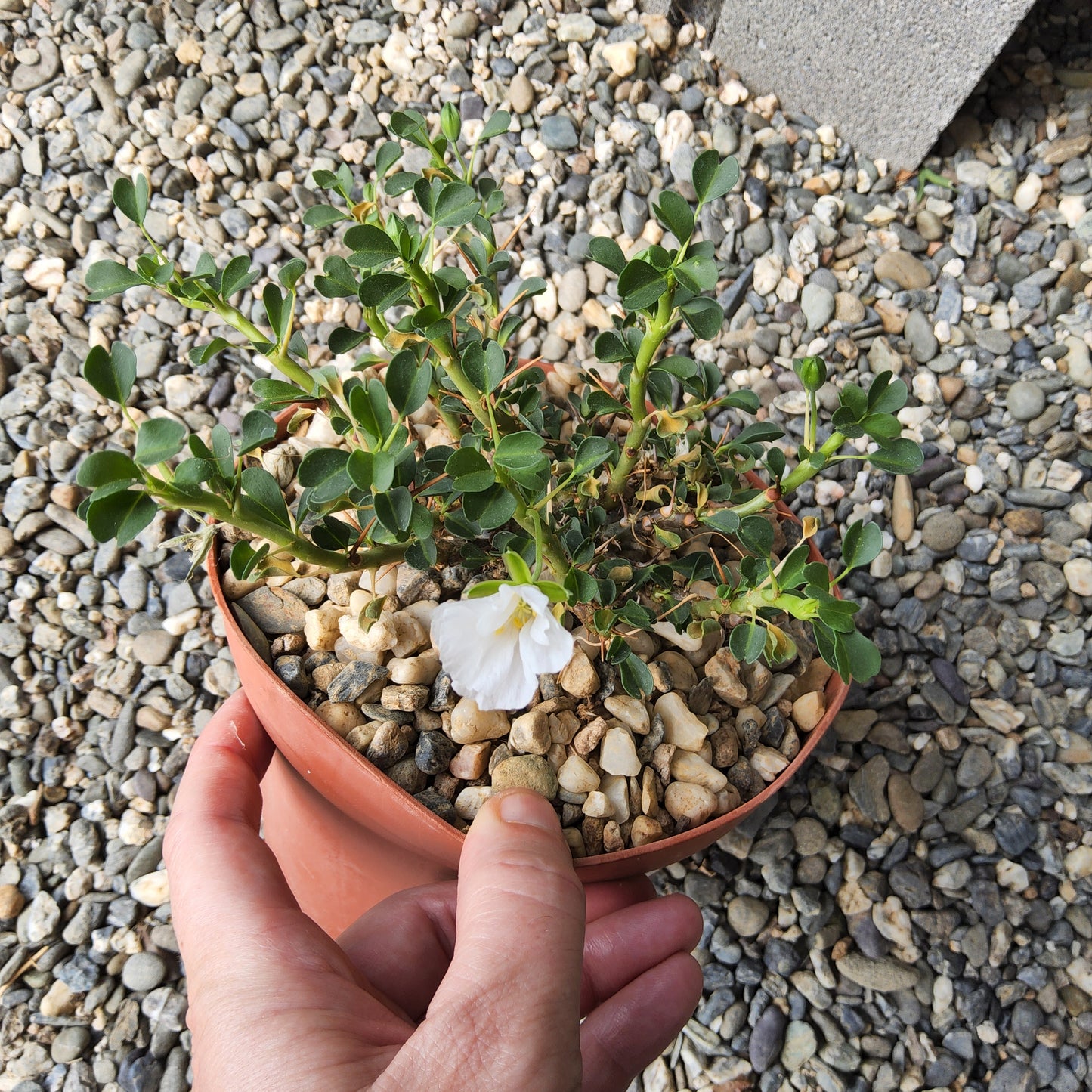
Sarcocaulon vanderietiae | Bushman's Candle | South African Caudiciform | Collector Succulent Growing in a 6"
Sarcocaulon vanderietiae | Bushman's Candle | South African Caudiciform | Collector Succulent Growing in a 6"
Couldn't load pickup availability
Sarcocaulon vanderietiae, commonly known as Bushman's Candle or Candle Bush, is one of the most distinctive caudiciform shrubs native to South Africa. Admired for its thick, wax-coated succulent stems, formidable spines, and delicate flowers, this remarkable member of the geranium family (Geraniaceae) combines rugged desert adaptations with surprising elegance. Over time, it develops into a compact, sculptural specimen whose gnarled branches and seasonal foliage make it a favorite among collectors of African caudiciforms.
Like other members of the genus, the stems are covered by a highly flammable resinous wax layer—a remarkable adaptation that inspired the common name "Bushman's Candle." Historically, dried branches could be used as natural torches, burning even when freshly cut. Combined with its unusual growth habit and attractive blooms, this species has become one of the most sought-after members of the genus.
Native Habitat:
Endemic to the Eastern Cape Province of South Africa, where it occurs primarily between the Sundays River and the Great Fish River valleys. It grows in the Albany Thicket and adjacent semi-Karoo vegetation on rocky hillsides, quartzite outcrops, gravelly slopes, and shallow shale-derived soils at elevations from near sea level to approximately 400 meters (1,300 feet). This region experiences hot, dry summers, mild winters, and relatively low, unpredictable rainfall, with plants adapted to prolonged drought and excellent natural drainage.
Flowering Information:
Mature plants produce attractive white to pale cream flowers, often with delicate pink to salmon-colored markings near the center, during late spring through summer. The flowers are relatively large compared to the plant's compact stature and provide a striking contrast against the spiny, gray-green stems. When successfully pollinated, they develop elongated seed capsules typical of the geranium family.
Soil Type:
Requires an exceptionally fast-draining mineral substrate consisting of pumice, coarse sand, crushed quartzite, decomposed granite, and fine gravel, with very little organic matter. Replicating its naturally rocky habitat is essential for maintaining healthy roots and preventing rot.
Hardiness:
USDA Zones 9b–11. Mature plants can tolerate brief temperatures near 28°F (-2°C) when kept completely dry but should be protected from prolonged frost and excessive winter moisture. Good air circulation is beneficial throughout the year.
Light Requirements:
Thrives in full sun to bright filtered light. Strong light encourages compact branching, healthy spine development, and prolific flowering. In extremely hot inland climates, light afternoon shade may help prevent stress during periods of intense summer heat.
Propagation:
Primarily propagated from seed, producing plants with the strongest natural form and well-developed succulent stems. Stem cuttings are possible but are less commonly used, as seed-grown plants generally develop superior architecture and are preferred by collectors.
Collector's Note:
The specific epithet vanderietiae honors Mrs. Van de Riet, who collected the type specimen from which the species was originally described. Modern taxonomic treatments differ regarding the genus: some authorities transferred the species to Monsonia vanderietiae, while others, including World Flora Online, continue to recognize Sarcocaulon vanderietiae. Likewise, Royal Botanic Gardens, Kew currently treats Monsonia vanderietiae as a synonym of Sarcocaulon vanderietiae. Regardless of the generic placement, the horticultural name Sarcocaulon remains firmly established among collectors and accurately conveys this group's unique combination of succulent, wax-covered stems and geranium-like flowers. Its restricted distribution within South Africa's Eastern Cape and remarkable ecological adaptations make it one of the finest representatives of the African caudiciform flora.
This is for one plant similar to the one shown growing in a 6" container shipped bare root. All of our plants are guaranteed pest-free and healthy upon delivery, and we ship within the United States. Shipping is done Monday thru Friday.
Any questions please ask.
#prsucculents
Share