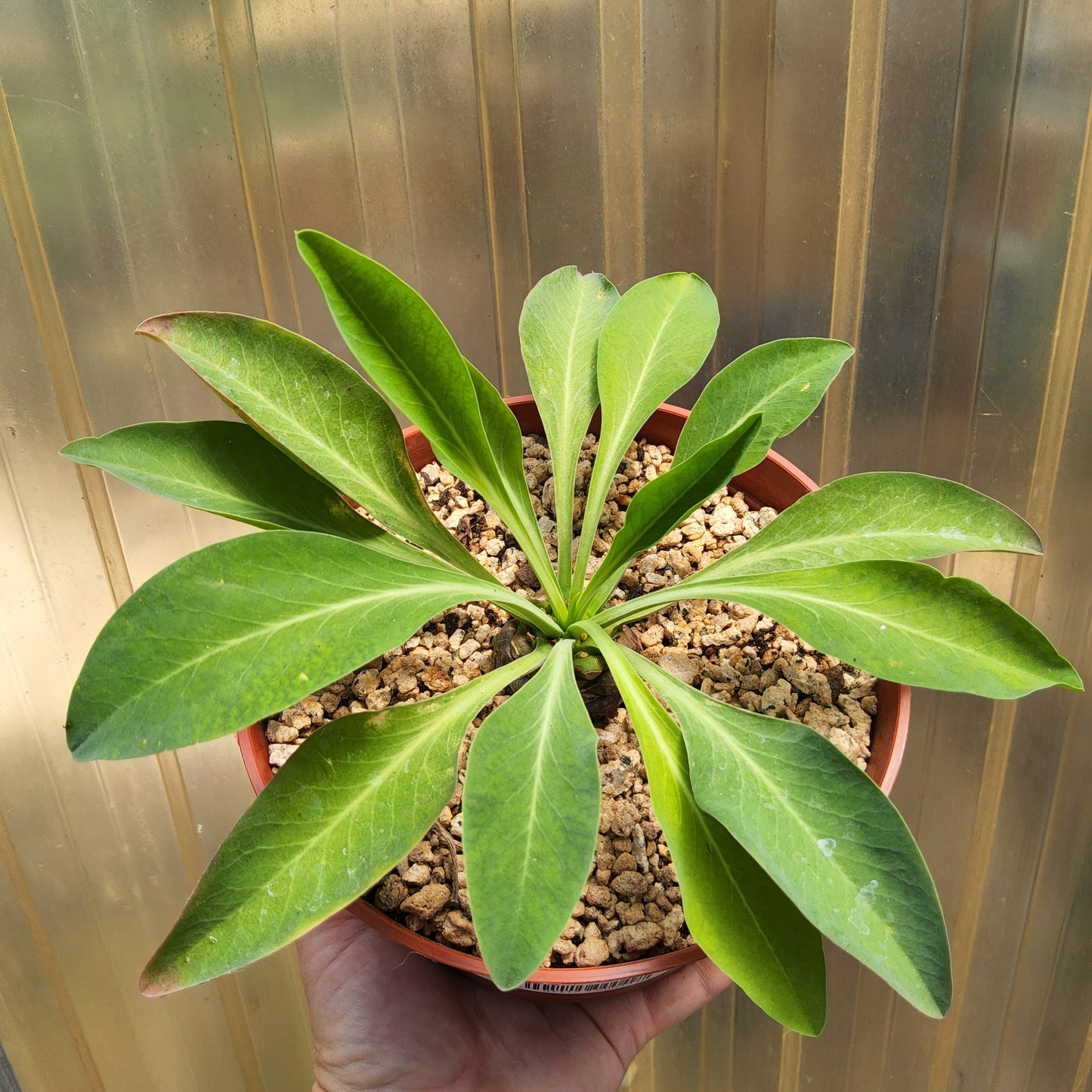
Euphorbia bupleurifolia | Pine Cone Euphorbia | South African Caudiciform | Collector Succulent in 6 Inch
Euphorbia bupleurifolia | Pine Cone Euphorbia | South African Caudiciform | Collector Succulent in 6 Inch
Couldn't load pickup availability
Euphorbia bupleurifolia is one of South Africa's most distinctive caudiciform succulents, immediately recognized by its solitary, pine cone-like stem covered with persistent leaf scars that form an intricate geometric pattern. During the growing season, a crown of elegant, narrow leaves emerges from the apex, creating a striking contrast between the rugged trunk and fresh foliage. As the plant matures, the stem slowly elongates while retaining its characteristic texture, producing one of the most architecturally unique forms in the succulent world.
Unlike many branching Euphorbias, Euphorbia bupleurifolia typically remains solitary throughout its life, making its bold, sculptural silhouette the focal point of the plant. Its exceptionally slow growth, remarkable longevity, and highly specialized adaptations to seasonal drought have made it one of the most desirable South African caudiciforms among collectors.
Native Habitat:
Euphorbia bupleurifolia is endemic to South Africa, where it occurs from the Makhanda (formerly Grahamstown) region of the Eastern Cape northward into KwaZulu-Natal, extending as far as the Pietermaritzburg area. It inhabits subarid grasslands, open savanna, thornveld, and open thicket, where it typically grows on shallow, well-drained acidic sandy or loamy soils with sparse grass cover, often in association with dolerite bedrock on gently sloping hillsides. During the dry season the plant becomes almost invisible among dormant grasses, while periodic fires reduce competing vegetation and create favorable conditions for seed germination. Throughout its range, the climate is characterized by warm, wet summers and cool, comparatively dry winters. Rather than relying on a large underground caudex, the species stores water within its thickened stem, allowing it to survive prolonged seasonal drought.
Flowering Information:
Flowering occurs from midwinter through midsummer (approximately July through January in habitat). Mature plants produce small yellow-green cyathia that often become flushed with pink or reddish tones as they age. Euphorbia bupleurifolia is primarily dioecious, with individual plants producing either staminate (male) or pistillate (female) cyathia. Successful seed production therefore normally requires both a male and a female plant flowering simultaneously. Interestingly, this species is one of the few succulent Euphorbias known to exhibit sex plasticity. Individual plants have occasionally been observed to change sex between flowering seasons and, more rarely, produce bisexual cyathia, making its reproductive biology unusually complex within the genus. Mature seed capsules split explosively when dry, dispersing the seeds only a short distance from the parent plant.
Soil Type:
Grow in a sharply draining mineral substrate consisting of pumice, coarse sand, decomposed granite, fine gravel, and a modest amount of organic material. Slightly acidic growing media with excellent drainage closely replicate its native soils. While the plant appreciates regular moisture during active summer growth, the growing medium should never remain waterlogged.
Hardiness:
USDA Zones 10–11. Best protected from frost and prolonged cold. During winter dormancy, reduce watering significantly and maintain temperatures above 50°F (10°C) whenever possible. Mature plants tolerate brief periods of cooler temperatures if kept completely dry, but excessive winter moisture is a far greater risk than cold itself.
Light Requirements:
Thrives in bright light, morning sun, or light afternoon shade. In cultivation, bright filtered light often produces the healthiest foliage while maintaining compact growth. Plants appreciate warmth and regular moisture during active growth but should be allowed a cool, dry winter rest.
Propagation:
Euphorbia bupleurifolia is propagated almost exclusively from seed, producing plants that develop the species' characteristic solitary stem and natural architecture. Because the species is normally unbranched, vegetative propagation is rarely practical. In the uncommon event that a cutting can be rooted, it is unlikely to recreate the natural growth form of a seed-grown specimen. As with all Euphorbias, damaged tissues exude a milky white latex that can irritate the skin and eyes and should be handled with care.
Collector's Note:
The specific epithet bupleurifolia means "with leaves like Bupleurum", referring to the resemblance of its narrow leaves to those of the herbaceous genus Bupleurum. The distinctive pine cone appearance is created by the persistent bases of old leaves, which remain attached to the stem for many years and form the plant's characteristic geometric pattern. Although widespread within its native range and currently assessed as Least Concern, wild populations are under localized pressure from unsustainable collection for traditional medicinal use and are protected under CITES Appendix II, requiring permits for international trade. Recent field studies also indicate that natural recruitment is often low, with mature plants greatly outnumbering seedlings, highlighting the importance of responsible cultivation and seed propagation in conserving this remarkable South African species.
This is for one plant similar to the one shown growing in a 6" inch container shipped bare root. All of our plants are guaranteed pest-free and healthy upon delivery, and we ship within the United States. Shipping is done Monday thru Friday.
Any questions please ask.
#prsucculents
Share