Echinocereus ledingii | Leding’s Hedgehog Cactus | Arizona Mountain Collector Cactus
Echinocereus ledingii | Leding’s Hedgehog Cactus | Arizona Mountain Collector Cactus
Couldn't load pickup availability
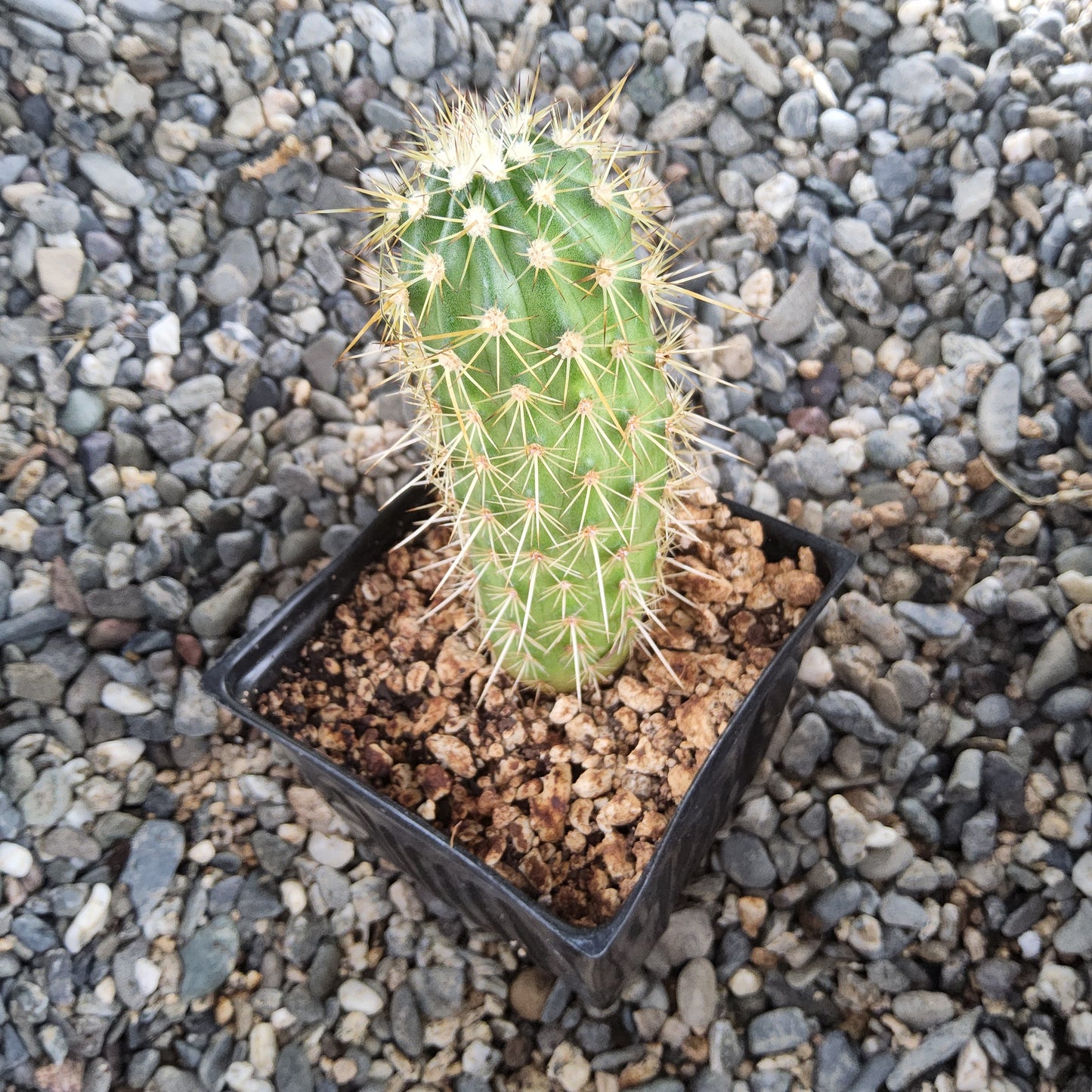
Echinocereus ledingii is a distinctive mountain-dwelling cactus native to a limited area of southeastern Arizona, where it grows on rocky slopes in interior chaparral and open oak woodland. Mature plants form relatively open clusters of upright cylindrical stems, typically developing 4–15 branches from the base. Individual stems can reach approximately 15–50 cm (6–20 inches) tall and 6–8 cm (2.4–3.1 inches) in diameter.
The stems carry approximately 12–14, occasionally up to 16 ribs, with pale to golden-yellow radial spines and one or more stronger central spines. The characteristic central spine may curve sharply downward near its base, although this feature is variable and is not by itself sufficient for identification. Mature plants produce beautiful magenta to rose-pink flowers, giving a striking contrast against the golden spination and upright green stems.
Native Habitat:
Echinocereus ledingii is endemic to southeastern Arizona, with reliably documented populations in the Pinaleño (Graham), Santa Teresa, and Chiricahua Mountains.
Plants occur at approximately 1,200–2,000 meters (3,940–6,560 feet) elevation on rocky mountain slopes, interior chaparral, and oak woodland, with populations particularly associated with igneous substrates. This geology is an important part of its ecology and distinguishes it from many cacti associated primarily with limestone.
The xerophytic communities occupied by E. ledingii can contain an impressive assortment of other drought-adapted plants. Ecological-site records encompassing habitat for E. ledingii also document species such as Echinocereus fendleri, Echinocereus rigidissimus, Echinomastus intertextus, Escobaria vivipara, Ferocactus wislizeni, Mammillaria grahamii, Mammillaria heyderi var. macdougalii, and Agave parryi.
Another particularly interesting succulent with documented habitat overlap is Graptopetalum rusbyi, a small Crassulaceae species of rocky Arizona canyon slopes. Habitat records for G. rusbyi specifically list Echinocereus ledingii among its accompanying plants, together with xerophytes including Mammillaria viridiflora and other southwestern cacti.
Flowering Information:
Flowering occurs primarily during May and June in habitat. The flowers are broadly funnel-shaped and approximately 5–6 cm (2–2.4 inches) long and wide, with magenta to rose-pink inner tepals that become darker toward the base and contrasting yellow anthers.
The fruit is fleshy, approximately 20–30 mm long, initially green and sometimes developing reddish or brownish coloration. In habitat, fruits mature approximately three and a half months after flowering.
Soil Type:
Grow in an exceptionally well-drained, predominantly mineral substrate that reflects the species' rocky, igneous mountain habitat. A mixture containing pumice, lava rock, decomposed granite, coarse grit, and a modest amount of organic material is appropriate.
There is no ecological reason to build the mix around limestone for this species. Excellent drainage and strong root aeration are considerably more important.
Water thoroughly during active spring and summer growth, allowing the substrate to dry well between waterings. Reduce watering substantially as temperatures fall and keep the root system comparatively dry during winter.
Hardiness:
A practical conservative range is approximately USDA Zones 8b–10, provided plants have excellent drainage and remain relatively dry during freezing weather.
Cultivation references have reported dry tolerance approaching approximately 10°F (-12°C) for Echinocereus ledingii, but this should be considered an approximate lower survival limit rather than a routine cultivation temperature. Provenance, acclimation, duration of freezing, and especially winter moisture can dramatically affect cold tolerance.
Its natural occurrence as high as approximately 2,000 meters confirms that this is a genuinely cold-tolerant mountain cactus rather than a frost-sensitive low-desert species. Cold combined with saturated soil remains considerably more hazardous than brief dry frost.
Light Requirements:
Provide bright light to full sun, with particularly strong illumination during spring and autumn. Adequate light encourages compact stems, strong golden spination, and dependable flowering.
Because natural populations also occur within interior chaparral and open oak woodland, plants do not necessarily require relentless exposed desert sun. In very hot low-elevation climates, some protection from intense afternoon summer heat can be beneficial.
Propagation:
Propagation is primarily from seed, especially when maintaining geographically documented material. Seed-grown plants develop the natural growth habit of the species and preserve genetic variation within individual mountain populations.
Mature specimens naturally branch from the base and can develop 4–15 stems, so established plants may also provide offsets suitable for vegetative propagation.
Collector's Note:
Echinocereus ledingii was described by Robert Hibbs Peebles in 1936 in the Cactus and Succulent Journal. The type was collected by Louis Wankum on July 11, 1935, on Mt. Graham in Graham County, Arizona, at approximately 4,500 feet elevation; the type specimen is recorded as US 1634004.
The species was named in honor of A. R. Leding, an early student and collector of southwestern cacti. Historical Smithsonian records document A. R. Leding supplying Arizona cactus collections during the 1920s, providing additional context for his involvement with the southwestern cactus flora.
The species has periodically been treated as Echinocereus fendleri var. ledingii, particularly following Nigel P. Taylor's 1985 combination. Kew's Plants of the World Online currently accepts Echinocereus ledingii as a distinct species and treats Echinocereus fendleri var. ledingii as a synonym.
Identification requires some care. The strongly downward-curving central spine historically associated with E. ledingii can also occur in Echinocereus coccineus and E. arizonicus. Modern work therefore rejects many older locality reports and restricts confidently documented populations to the Pinaleño, Santa Teresa, and Chiricahua Mountains.
That restricted mountain distribution, preference for igneous rocky terrain, golden spination, magenta spring flowers, and association with Arizona's chaparral–oak woodland transition make Echinocereus ledingii an especially interesting species for collectors of geographically documented North American cacti.
This is for one plant similar to the one shown growing in a 4" inch container shipped bare root. All of our plants are guaranteed pest-free and healthy upon delivery, and we ship within the United States. Shipping is done Monday thru Friday.
Any questions please ask.
#prsucculents
Share