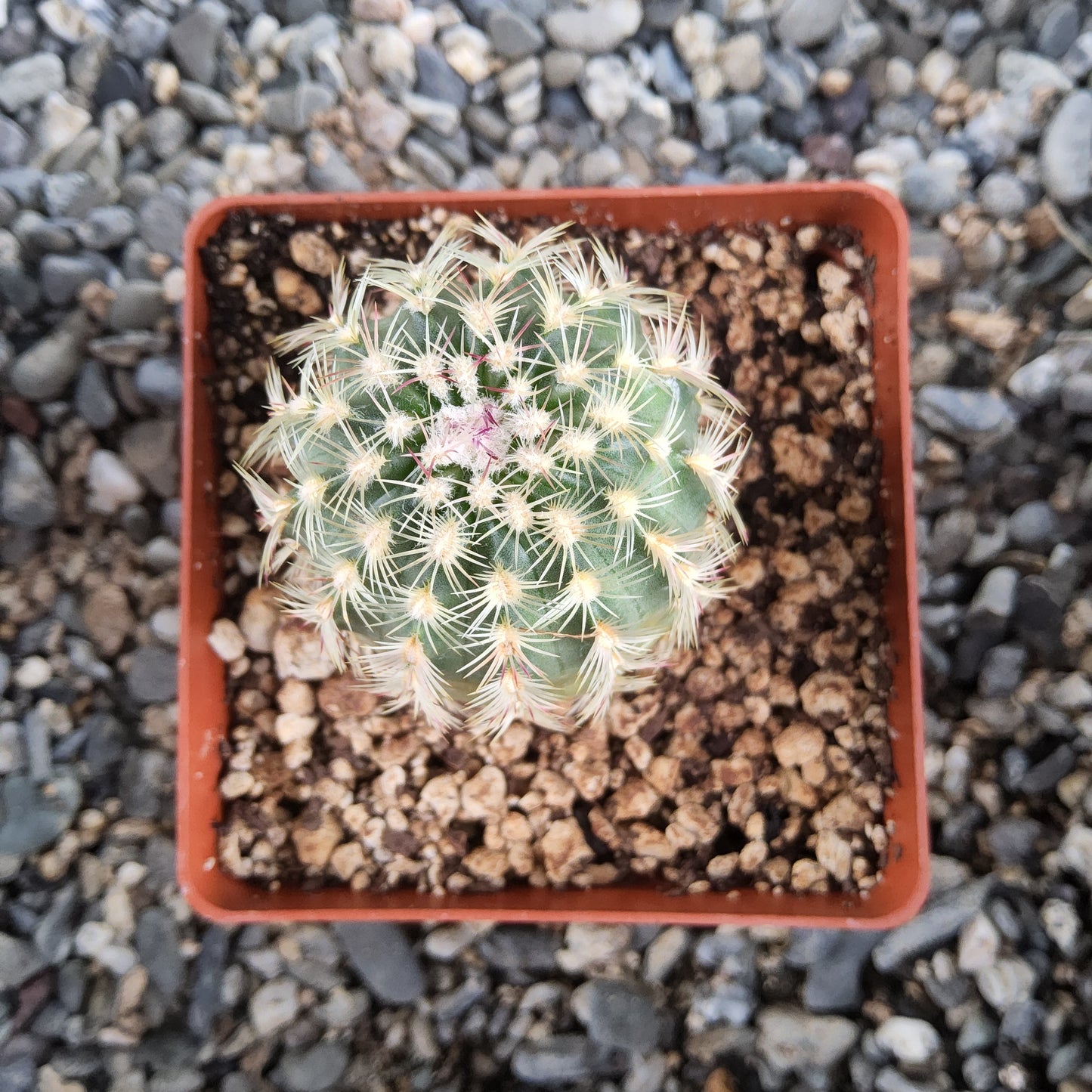
Echinocereus carmenensis | Chocolate-Scented Hedgehog Cactus | Sierra del Carmen, Coahuila | Collector Cactus Growing in 4 Inch
Echinocereus carmenensis | Chocolate-Scented Hedgehog Cactus | Sierra del Carmen, Coahuila | Collector Cactus Growing in 4 Inch
Couldn't load pickup availability
Echinocereus carmenensis is a distinctive Mexican hedgehog cactus native to the isolated Sierra del Carmen of northern Coahuila. This compact species is admired for its dense, finely arranged cream to yellowish spines, pale green body, and exceptionally unusual chocolate-scented flowers. The numerous radial spines lie closely against the stem in a pectinate, or comb-like, arrangement, often partially obscuring the body and giving mature plants a beautifully refined appearance.
One of the most fascinating characteristics of Echinocereus carmenensis appears during its juvenile stage. Some young seedlings initially develop conspicuous soft, flexible white hair-like spines, with the characteristic yellowish-white adult spination appearing only as the plants mature. Combined with its unusual greenish flowers and compact mountain growth habit, this makes E. carmenensis one of the most distinctive members of the broader Echinocereus viridiflorus complex.
Native Habitat:
Echinocereus carmenensis is endemic to the Sierra del Carmen region of Coahuila, Mexico, with documented populations around La Cuesta. Unlike many northern Mexican cacti associated primarily with exposed limestone, E. carmenensis has been specifically documented growing in red soil in a warm, dry mountain environment.
The species occurs at moderate elevations in the Sierra del Carmen, where plants experience strong sunlight, warm growing-season temperatures, cool nights, and a pronounced seasonal dry period. Its substantial root system allows it to make efficient use of seasonal moisture while surviving extended periods of drought. The combination of intense mountain light, rapid soil drainage, and dry winter conditions is an important consideration when reproducing its natural growing conditions in cultivation.
Flowering Information:
Mature plants generally flower during mid- to late spring, producing relatively small, funnel-shaped flowers from the sides of the stem. Flowers range from yellowish-green and olive-green to bronze-green or reddish-brown, often with subtle darker coloration along the outer tepals.
Perhaps the most remarkable characteristic of the flowers is their distinctive sweet chocolate-like fragrance, which has given the species the common name Chocolate-Scented Hedgehog Cactus.
The flowers are hermaphroditic, containing functional stamens and a functional pistil within each flower.
Soil Type:
Grow in a highly porous, predominantly mineral substrate consisting of pumice, coarse grit, decomposed granite, coarse sand, and only a small amount of organic material. Excellent drainage is especially important for this species, which is sensitive to prolonged moisture around its root system.
Because Echinocereus carmenensis develops a substantial root system, use a deeper container than the small above-ground stem might initially suggest. Avoid dense, moisture-retentive soils and allow the substrate to dry thoroughly between waterings.
Hardiness:
Best suited to USDA Zones 8–10. Established plants can tolerate brief freezes to approximately 14°F (-10°C) when completely dry, but cold combined with wet soil greatly increases the risk of root damage and rot.
Provide a cool, completely dry winter dormancy whenever possible. In climates with cold, wet winters, protected or frost-controlled cultivation is preferable to exposing plants to prolonged winter moisture.
Light Requirements:
Thrives in bright light to full sun, with strong illumination encouraging compact growth, dense spination, and dependable flowering. Plants should be gradually acclimated to intense sunlight, particularly when moving from greenhouse or indoor conditions.
In climates with exceptionally hot summer afternoons, some light afternoon protection can reduce the risk of sunburn while still providing the strong light necessary to maintain the species' characteristic form.
Propagation:
Primarily propagated from seed, which produces the characteristic natural growth form and preserves genetic diversity within cultivated populations. Seedlings are particularly interesting because some individuals pass through a distinctive juvenile stage characterized by soft white hair-like spination before developing the typical yellowish pectinate adult spines.
The species is generally solitary, although occasional mature specimens may produce offsets that can be rooted vegetatively. Because offset production is inconsistent, seed remains the preferred and most dependable method of propagation. Its substantial root system is a normal adaptation for water storage and survival in its seasonally dry mountain habitat.
Collector's Note:
Echinocereus carmenensis was formally described in 1998 by Wolfgang Blum, Michael Lange, and Egon Scherer. The type locality is the Sierra del Carmen, Coahuila, Mexico, and the type material is associated with the field collection SB 1476, a Steve Brack collection from the Sierra del Carmen.
Interestingly, plants corresponding to SB 1476 circulated through Mesa Garden for years before the species was formally described, initially under the provisional name Echinocereus chloranthus var. nova and later as Echinocereus russanthus var. nova. This history reflects the close relationship of E. carmenensis to the diverse viridiflorus/chloranthus/russanthus complex.
Some taxonomic treatments, including LLIFLE, have included E. carmenensis within a broader concept of Echinocereus viridiflorus. However, Plants of the World Online (Kew) currently accepts Echinocereus carmenensis as a distinct species. Its restricted Sierra del Carmen distribution, unusual juvenile spination, tightly pectinate adult spines, and unmistakably chocolate-scented greenish flowers make it one of the most fascinating and recognizable small species within the genus Echinocereus.
This is for one plant similar to the one shown growing in a 4" inch container shipped bare root. All of our plants are guaranteed pest-free and healthy upon delivery, and we ship within the United States. Shipping is done Monday thru Friday.
Any questions please ask.
#prsucculents
Share