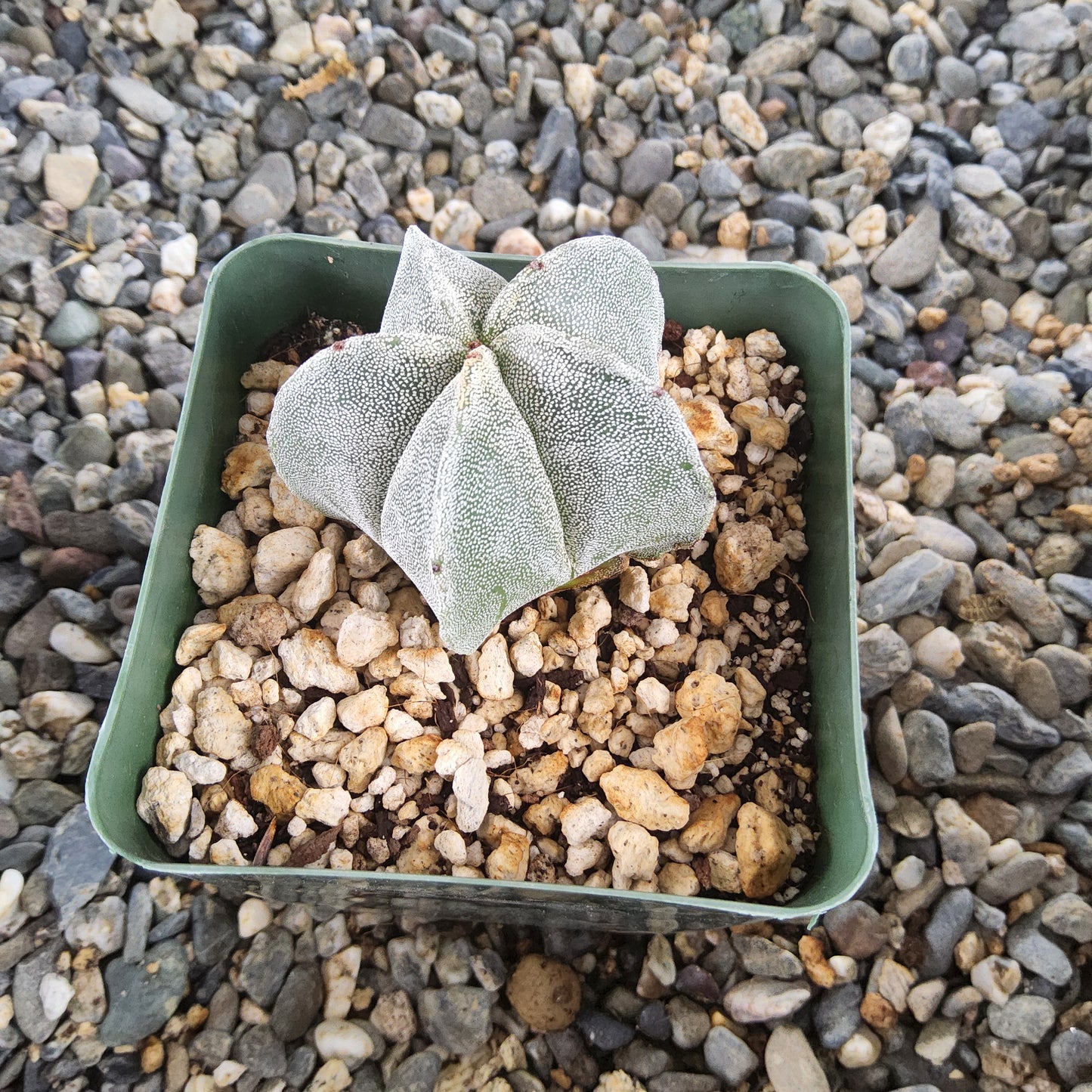
Astrophytum myriostigma var. strongylogonum, Villar, SLP | Mexican Collector Cactus Growing in 4 Inch
Astrophytum myriostigma var. strongylogonum, Villar, SLP | Mexican Collector Cactus Growing in 4 Inch
Couldn't load pickup availability
Astrophytum myriostigma var. strongylogonum 'Villar, SLP' is a distinctive locality form of the classic Bishop’s Cap cactus originating near Villar in eastern San Luis Potosí, Mexico. It is especially admired for its broad, low, strongly rounded ribs, which give mature plants a softer and more sculptural appearance than the sharply angled ribs commonly associated with typical Astrophytum myriostigma.
Plants are spineless and generally develop five ribs, although rib number can vary with age and individual genetics. The epidermis is covered with the characteristic white woolly flecks of A. myriostigma, creating a beautiful contrast against the gray-green underlying stem. Mature plants often become increasingly broad and columnar with age while retaining the rounded rib profile historically associated with strongylogonum.
Native Habitat:
The Villar population occurs near Estación Villar in San Luis Potosí, Mexico, an area historically associated with the type locality of Astrophytum myriostigma var. strongylogonum. Documented field collections from Villar have been recorded at approximately 1,500–1,590 meters (4,920–5,215 feet) elevation.
Plants grow on rocky limestone hills and open clearings within dry shrubland, where pale limestone fragments cover much of the soil surface. The open habitat provides intense sunlight and rapid drainage while surrounding shrubs offer varying amounts of natural shelter. Other specialized cacti have been documented growing in the same general habitat, illustrating the rich xerophytic flora of this region of San Luis Potosí.
Flowering Information:
Mature plants produce large bright yellow flowers from the woolly crown during the warm growing season. The flowers provide a striking contrast against the white-flecked, gray-green body and may be produced repeatedly on well-established specimens.
The flowers are hermaphroditic, containing functional stamens and a functional pistil within each flower.
Soil Type:
Grow in a highly porous, predominantly mineral substrate consisting of pumice, coarse limestone gravel, decomposed granite, coarse grit, and only a modest amount of organic material. Excellent drainage is essential, particularly during cool weather.
Although the Villar population occurs in limestone country, cultivation does not require pure limestone. The primary goal is a mineral-rich mixture that drains rapidly and does not remain saturated around the roots.
Hardiness:
Best suited to approximately USDA Zones 9–11. Established plants can tolerate brief light freezes to around 23°F (-5°C) when completely dry, but prolonged freezing temperatures and cold, wet soil should be avoided.
Provide a cool, dry winter dormancy, greatly reducing or withholding water during the coldest part of the year. Dry winter conditions are particularly important for maintaining a healthy root system.
Light Requirements:
Thrives in bright light to full sun, although plants should be gradually acclimated to intense exposure. Strong light promotes compact growth, broad ribs, heavy development of the characteristic white epidermal flecking, and dependable flowering.
In extremely hot climates, light afternoon protection can reduce heat stress while still maintaining the naturally compact growth form.
Propagation:
Propagation is primarily from seed. Seed-grown plants preserve the natural variation found within the Villar population and develop the symmetrical growth habit characteristic of the species.
Plants are normally solitary, so vegetative propagation is generally not practical. Grafting can accelerate growth but often produces a more inflated appearance than specimens maintained naturally on their own roots.
Collector’s Note:
Astrophytum myriostigma var. strongylogonum was formally published by Curt Backeberg in 1961, with the name traditionally associated with plants from the valley near Estación Villar, San Luis Potosí. The form is characterized especially by its broad, low, strongly rounded ribs, which distinguish mature plants visually from many populations of typical A. myriostigma.
Villar has a long history in cactus collecting. One particularly well-documented collection is Alfred Lau 728, collected at Villar on November 13, 1974, at approximately 1,500 meters elevation. Other collector accessions from the same locality further demonstrate the importance of Villar as a reference population for the strongylogonum phenotype.
Kew’s Plants of the World Online currently treats Astrophytum myriostigma var. strongylogonum as a synonym of Astrophytum myriostigma ssp. myriostigma, rather than recognizing it as a separate botanical variety. We however regard strongylogonum as an important historical and horticultural designation for this distinctive geographic phenotype.
The Villar locality remains particularly significant because it preserves both geographic provenance and the classic broad-ribbed morphology historically associated with the name strongylogonum.
This is for one plant similar to the one shown growing in a 4" inch container shipped bare root. All of our plants are guaranteed pest-free and healthy upon delivery, and we ship within the United States. Shipping is done Monday thru Friday.
Any questions please ask.
#prsucculents
Share