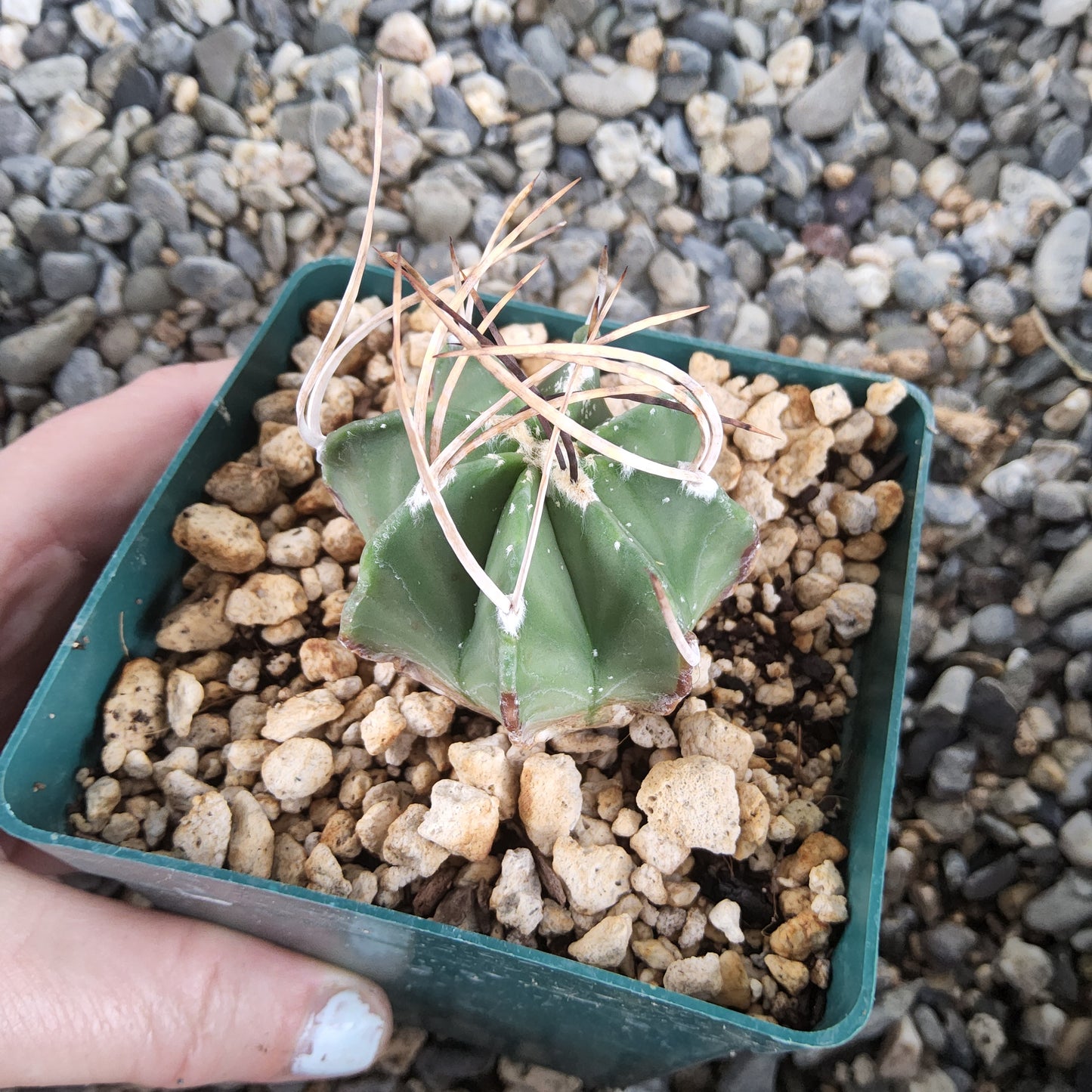
Astrophytum capricorne v. niveum f. nudum | Cuatro Ciénegas, Coahuila | Collector Cactus
Astrophytum capricorne v. niveum f. nudum | Cuatro Ciénegas, Coahuila | Collector Cactus
Couldn't load pickup availability
Astrophytum capricorne v. niveum f. nudum is a distinctive naked-bodied form associated with the Cuatro Ciénegas region of Coahuila, Mexico. Unlike typical var. niveum, which is famous for its exceptionally dense covering of white woolly flecks, the nudum form lacks most or all of this epidermal flocking, revealing the smooth green surface of the stem beneath. The result is a striking contrast between the clean green body and the long, powerful spines characteristic of the northern capricorne populations.
Plants begin globose and gradually become more cylindrical with age, developing the strongly ribbed, architectural form characteristic of Astrophytum capricorne. The spines are typically robust, flattened, and somewhat curved, emerging dark brown to nearly black before weathering to gray or chalky tones with age. The absence of dense white flecking makes the spine structure especially prominent and gives mature specimens a dramatically different appearance from typical var. niveum.
Native Habitat:
The niveum populations occur around Cuatro Ciénegas in central Coahuila, Mexico, within the Chihuahuan Desert. Typical var. niveum grows in rocky, gravelly soils among limestone outcrops and desert scrub, where plants experience intense sunlight, very low annual rainfall, hot summers, and regular winter cold. Associated cacti include Ariocarpus fissuratus, Lophophora williamsii, and Echinocactus horizonthalonius.
Plants matching the nudum phenotype were reported from approximately 10 kilometers west of Cuatro Ciénegas, where they occurred together with normally white-flecked niveum plants. This coexistence is particularly important because it supports the interpretation of nudum as a naturally occurring epidermal form within the same regional population rather than a completely separate geographic taxon.
Flowering Information:
Mature plants produce large, satiny yellow flowers with a deep red to orange-red throat, generally during the warmer growing season. Individual flowers may reach approximately 7–9 cm (2.8–3.5 inches) across and emerge from the woolly crown at the top of the plant.
The flowers are hermaphroditic, containing functional stamens and a functional pistil.
Soil Type:
Grow in a highly porous, predominantly mineral substrate consisting of pumice, coarse grit, limestone gravel, decomposed granite, and only a modest amount of organic material. Excellent drainage is essential, particularly during cool weather.
Although these plants originate from limestone-rich desert habitat, the most important cultivation requirement is a mineral mix that drains rapidly and does not remain saturated around the roots. Avoid overly rich soil, which can encourage soft or unnaturally elongated growth.
Hardiness:
Best suited to approximately USDA Zones 9–11. Established plants can tolerate brief light freezes approaching 20°F (-7°C) when completely dry, but prolonged freezing conditions combined with moisture should be avoided.
Provide a cool, completely dry winter dormancy whenever possible. Water should be greatly reduced or withheld once nighttime temperatures remain consistently cool.
Light Requirements:
Thrives in bright light to full sun. Strong illumination encourages compact growth, sturdy spine development, and dependable flowering.
Plants grown under greenhouse conditions should be gradually acclimated before exposure to intense outdoor sun. Good air circulation is especially important during warm weather and after watering.
Propagation:
Propagation is primarily from seed. Seed-grown plants preserve the natural variability present within the Cuatro Ciénegas populations and develop the characteristic growth form of the species.
Because Astrophytum capricorne normally remains solitary and only rarely produces offsets, vegetative propagation is generally not practical. Seedlings displaying the nudum phenotype can vary in the degree of epidermal flecking.
Collector's Note:
The taxonomic history of this plant is unusually complicated. The densely white-flecked niveum form was originally described in 1933 as Echinocactus capricornis var. niveus by K. Kayser following the discovery of these distinctive northern populations near Cuatro Ciénegas. It was later transferred into Astrophytum and became widely known as Astrophytum capricorne var. niveum.
The naturally occurring plants lacking the characteristic white flecking have circulated among collectors under names including Astrophytum capricorne var. niveum f. nudum, A. capricorne f. nudum, and historically in association with var. crassispinum. This overlap in naming reflects the considerable natural variation within the Astrophytum capricorne populations of the Cuatro Ciénegas region.
This is for one plant similar to the one shown growing in a 4" inch container shipped bare root. All of our plants are guaranteed pest-free and healthy upon delivery, and we ship within the United States. Shipping is done Monday thru Friday.
Any questions please ask.
#prsucculents
Share