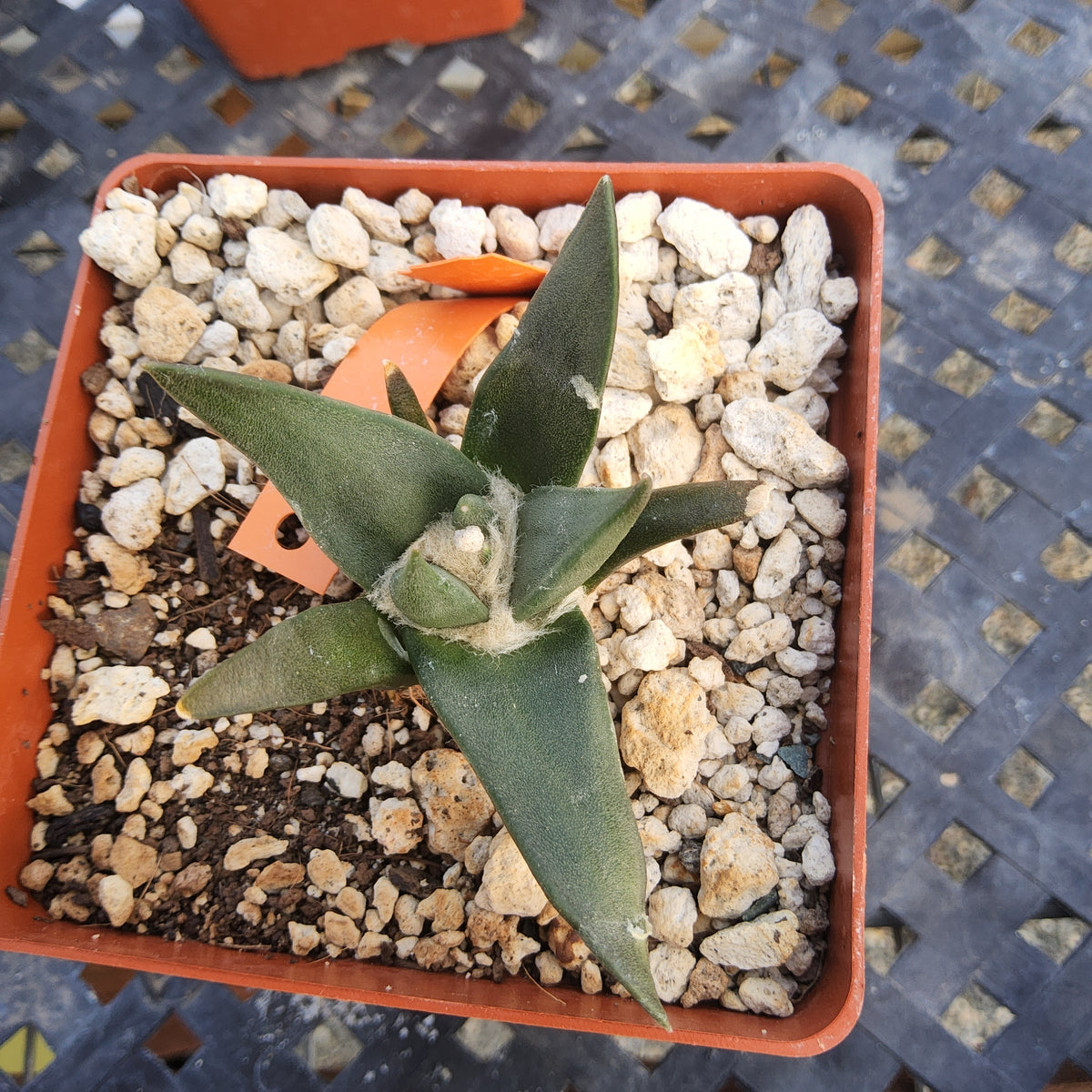
Ariocarpus trigonus | Yellow-Flowered Living Rock | Tamaulipas & Nuevo León Collector Cactus
Ariocarpus trigonus | Yellow-Flowered Living Rock | Tamaulipas & Nuevo León Collector Cactus
Couldn't load pickup availability
Ariocarpus trigonus is a distinctive Mexican living-rock cactus recognized by its unusually long, narrow, sharply pointed tubercles and cream-yellow to yellow flowers. The plant forms a low, solitary rosette of yellow-green to gray-green tubercles surrounding a woolly central crown, while a substantial taproot remains concealed below the soil surface.
It is among the larger members of Ariocarpus, with mature plants occasionally approaching 30 cm (12 inches) across. Individual tubercles are generally 3–8 cm long and 1–2.5 cm wide, often approximately twice as long as broad, although considerable geographic variation occurs throughout its extensive north-south range. The narrow, elongated tubercles give A. trigonus a considerably more open and star-like appearance than typical A. retusus.
Native Habitat:
Ariocarpus trigonus is native to Tamaulipas and Nuevo León, Mexico. Kew recognizes these two states as its native range.
The species has an unusually extensive distribution for an Ariocarpus. In Tamaulipas it occurs through portions of the Sierra de San Carlos, Gulf Coastal Plain, Jaumave Valley, and Palmillas region, while northern populations extend into Nuevo León. Its habitats span both Chihuahuan Desert vegetation and Tamaulipan thorn scrub.
Many populations occur on limestone-derived terrain, including low rocky ridges, stony plains, and limestone hills. In the Jaumave and Palmillas valleys, populations are generally found around 600–1,000 meters (1,970–3,280 feet), while northern populations on the Gulf Coastal Plain can occur substantially lower, around 150–450 meters (490–1,475 feet).
Habitat can vary considerably even within the species. Around Palmillas, Tamaulipas, large plants frequently grow sheltered beneath low thorn scrub, while populations north of Monterrey occur on flat stony ground beneath scattered shrubs.
The surrounding succulent and xerophytic flora is correspondingly diverse. Documented vegetation within A. trigonus communities includes Agave lechuguilla, Yucca filifera, Hechtia glomerata, Euphorbia antisyphilitica, Cylindropuntia imbricata, Opuntia species, and numerous other cacti.
In lower-elevation Tamaulipan thorn scrub where A. trigonus occurs, characteristic cacti include Astrophytum asterias, Echinocactus texensis, Echinocereus berlandieri, Echinocereus pentalophus, Ferocactus hamatacanthus, and Hamatocactus setispinus.
At a documented population near Fortín Agrario, Tamaulipas, A. trigonus grows on low limestone ridges together with Astrophytum asterias, Thelocactus bicolor var. schwarzii, and Ancistrocactus scheeri.
Flowering Information:
Mature plants generally flower during late autumn into early winter, with blossoms emerging from the dense woolly center of the rosette.
Flowers are approximately 3–5 cm (1.2–2 inches) across and range from cream-white and yellowish-white to clear yellow, sometimes with subtle reddish midstripes.
The predominantly yellow flowers are one of the most useful characteristics separating typical Ariocarpus trigonus from the primarily white- to pink-flowered Ariocarpus retusus complex.
Soil Type:
Grow in an exceptionally fast-draining, predominantly mineral substrate.
A suitable mixture can contain pumice, coarse limestone gravel, decomposed granite, lava rock, and coarse grit, with only a small amount of organic material.
The thick taproot requires excellent drainage and sufficient depth. A deep container is preferable so the root system can develop naturally without remaining compressed or persistently wet.
Water thoroughly during active warm-weather growth, then allow the substrate to dry completely before watering again. Reduce irrigation sharply as temperatures cool and keep plants substantially dry during winter.
Hardiness:
A practical conservative cultivation range is approximately USDA Zones 8b–11 under dry, well draining conditions.
Established plants can tolerate brief temperatures approaching approximately 14°F (-10°C) when completely dry, but this should be considered an approximate survival limit rather than a routine cultivation temperature.
As with other Ariocarpus, cold combined with moisture is substantially more dangerous than brief dry frost.
Light Requirements:
Provide bright light to full sun, although some protection from extreme afternoon heat can be beneficial in very hot inland climates.
Natural plants frequently receive partial protection from surrounding thorn scrub, particularly in western portions of the Jaumave Valley and around Palmillas.
Strong light encourages compact growth and natural tubercle proportions. Greenhouse-grown specimens should be gradually acclimated before exposure to intense outdoor sunlight.
Propagation:
Propagation is primarily from seed.
Ariocarpus trigonus is considered one of the more manageable members of the genus to raise from seed, although growth remains slow compared with ordinary cacti. Seed-grown plants generally require approximately 7–10 years to reach flowering size under good cultivation.
Grafting can greatly accelerate growth but frequently produces more inflated bodies and less natural proportions than plants maintained on their own roots.
Collector's Note:
The plant was originally described by Frédéric Albert Constantin Weber in 1893 as Anhalonium trigonum. Karl Moritz Schumann transferred it to Ariocarpus in 1898, establishing the familiar name Ariocarpus trigonus.
For many years, an alternative treatment placed it within Ariocarpus retusus as:
Ariocarpus retusus ssp. trigonus
That treatment remains common in older specialist literature and is still followed by some cactus references.
Kew's Plants of the World Online currently takes a different position and accepts Ariocarpus trigonus as a distinct species. Ariocarpus retusus ssp. trigonus is treated as a synonym of Ariocarpus trigonus.
This is therefore one case where Kew and LLIFLE currently differ: LLIFLE retains the broader Ariocarpus retusus ssp. trigonus treatment, while Kew recognizes Ariocarpus trigonus at species rank.
The species is exceptionally variable throughout its long distribution. Southern plants from the Jaumave and Palmillas valleys often develop particularly long, narrow tubercles, while populations farther north may have shorter and broader tubercles.
Populations around Aramberri and Zaragoza, Nuevo León are particularly interesting because natural hybris of A. trigonus and A. retusus have historically been called Ariocarpus confusus. These populations can also produce flowers ranging from white through pink or magenta rather than the typical yellowish flowers of A. trigonus.
This is for one plant similar to the one shown growing in a 4" inch container shipped bare root. All of our plants are guaranteed pest-free and healthy upon delivery, and we ship within the United States. Shipping is done Monday thru Friday.
Any questions please ask.
#prsucculents
Share