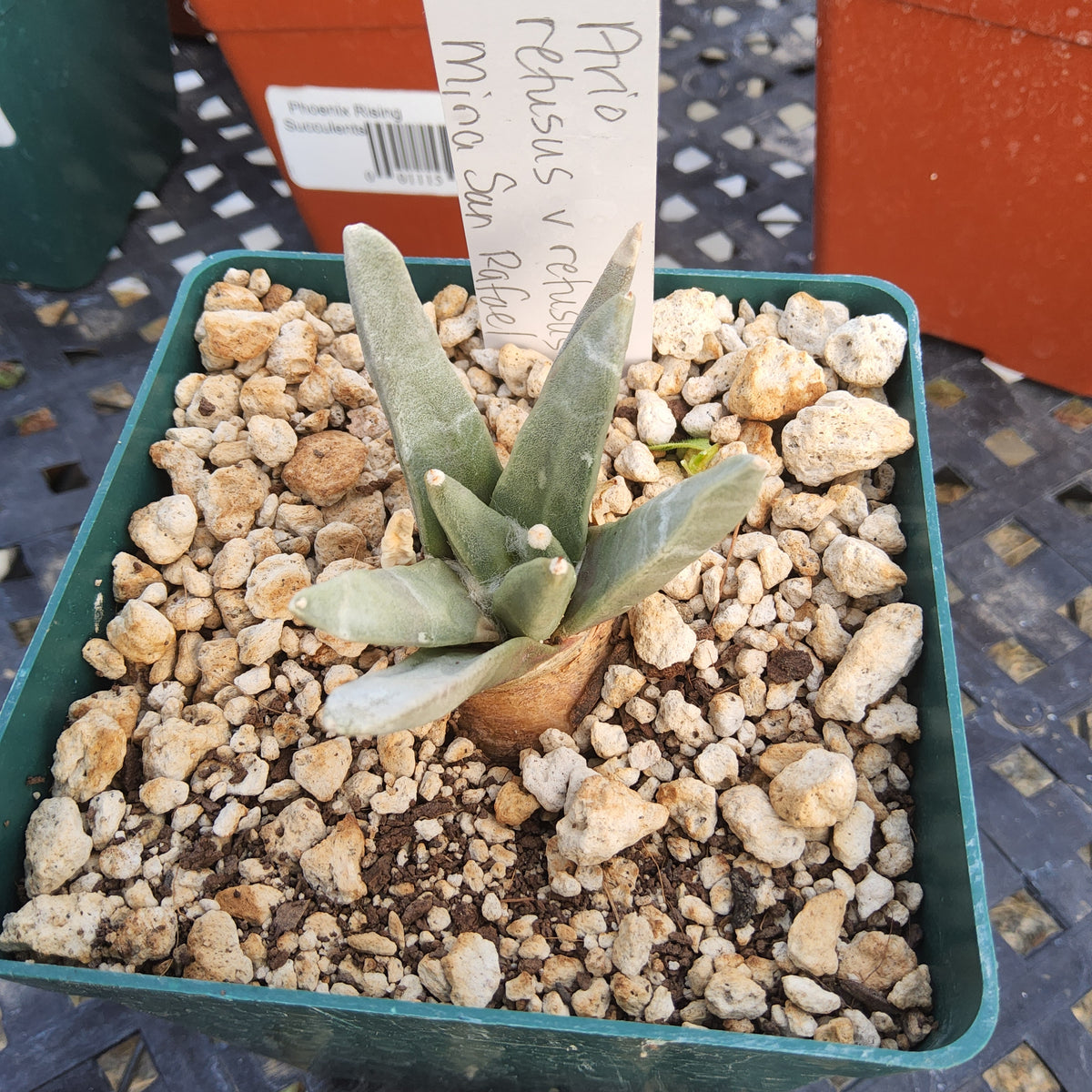
Ariocarpus retusus v. retusus | Mina San Rafael, SLP | Dwarf Living Rock Collector Cactus
Ariocarpus retusus v. retusus | Mina San Rafael, SLP | Dwarf Living Rock Collector Cactus
Couldn't load pickup availability
Ariocarpus retusus v. retusus ‘Mina San Rafael’ is a distinctive locality form of the highly variable Ariocarpus retusus complex from Mina San Rafael, San Luis Potosí, Mexico. Material circulating under this locality is characterized by a comparatively compact rosette with narrow, elongated gray-green tubercles that tend to grow more upright than those of many broader, heavier-tubercled forms of A. retusus.
Cultivated Mina San Rafael material has been described as relatively small-growing, with mature rosettes around 6 inches (15 cm) across. Like other Ariocarpus, the plant remains extremely low to the ground, with most of its substantial body and taproot hidden beneath the soil surface. This geophytic growth habit makes mature plants appear almost embedded in the surrounding substrate.
Native Habitat:
The locality name refers to Mina San Rafael, also recorded historically as Minas de San Rafael, in San Luis Potosí, Mexico. Botanical records place Minas de San Rafael in the Villa Juárez–Cerritos region of San Luis Potosí.
Across its broader range, A. retusus inhabits the high Chihuahuan Desert, generally around 1,300–2,000 meters elevation, favoring rocky slopes and especially limestone-associated semi-desert vegetation.
The Mina San Rafael locality itself has an especially interesting documented succulent flora. Turbinicarpus laui has been collected there under MZ 1114, while Paul Hoxey recorded the same locality as Minas de San Rafael under PH 52.01.
Mammillaria pilispina was originally described from Minas de San Rafael, municipality of Villa Juárez, making this locality its type area. The surrounding rosetophyllous desert scrub supports xerophytes including Agave lechuguilla, Hechtia glomerata, Dasylirion, Astrophytum myriostigma, and Coryphantha species.
Another remarkable xerophyte tied directly to the locality is Dasylirion longistylum, whose type collection was made at Minas de San Rafael in 1911.
Flowering Information:
Mature plants flower primarily during autumn, producing large flowers from the dense woolly center of the rosette.
Typical nominate Ariocarpus retusus produces cream to white flowers, sometimes with subtle reddish midveins. Across the broader species, pale pink coloration can also occur. Flowers generally reach approximately 4–5 cm (1.6–2 inches) across.
Cultivated Mina San Rafael material is specifically reported as producing white flowers, consistent with typical var. retusus.
Soil Type:
Grow in an exceptionally fast-draining, predominantly mineral substrate. A suitable mixture can contain pumice, limestone gravel, decomposed granite, coarse grit, and only a small amount of organic material.
The massive taproot requires both excellent drainage and sufficient depth. A deep container is preferable to a shallow pot so the root system can develop naturally without remaining compressed against the bottom of the container.
Water thoroughly during active warm-weather growth and allow the substrate to dry completely between waterings. As temperatures cool, reduce watering substantially and keep plants dry whenever freezing weather is possible.
Hardiness:
A practical conservative range is approximately USDA Zones 8b–11 when plants are maintained under dry, well draining conditions.
Established Ariocarpus retusus can tolerate brief temperatures around 14°F (-10°C) when completely dry, but this should be regarded as an approximate survival limit rather than a routine cultivation temperature.
Cold combined with moisture is considerably more dangerous than dry frost, particularly because the large fleshy taproot is highly susceptible to rot.
Light Requirements:
Provide bright light to full sun, with some protection from extreme afternoon summer sun in very hot climates.
Strong light encourages compact growth and helps prevent the elongated, overly lush growth that can develop under excessive shade or rich cultivation.
Greenhouse-grown plants should be gradually acclimated before exposure to intense outdoor sunlight.
Propagation:
Propagation is primarily from seed.
Ariocarpus retusus is considered one of the more manageable species of the genus to raise from seed, although seedlings remain slow compared with ordinary cacti and typically require approximately 6–10 years to reach flowering size.
Grafting can dramatically accelerate growth but often produces more inflated bodies and less natural proportions than specimens maintained on their own roots.
For Mina San Rafael locality material, seed propagation is especially valuable because it preserves the geographic provenance and natural variation represented by the population.
Collector's Note:
Ariocarpus retusus was described by Michael Joseph François Scheidweiler in 1838 and remains the accepted botanical species under Kew's Plants of the World Online. Kew presently treats the numerous named forms and varieties within the retusus complex broadly under Ariocarpus retusus.
The Mina San Rafael form has circulated in specialist cultivation as a recognizable locality form characterized by narrower gray-green tubercles, a relatively upright tubercle orientation, and a compact rosette reportedly reaching around 6 inches across.
This is for one plant similar to the one shown growing in a 4" inch container shipped bare root. All of our plants are guaranteed pest-free and healthy upon delivery, and we ship within the United States. Shipping is done Monday thru Friday.
Any questions please ask.
#prsucculents
Share