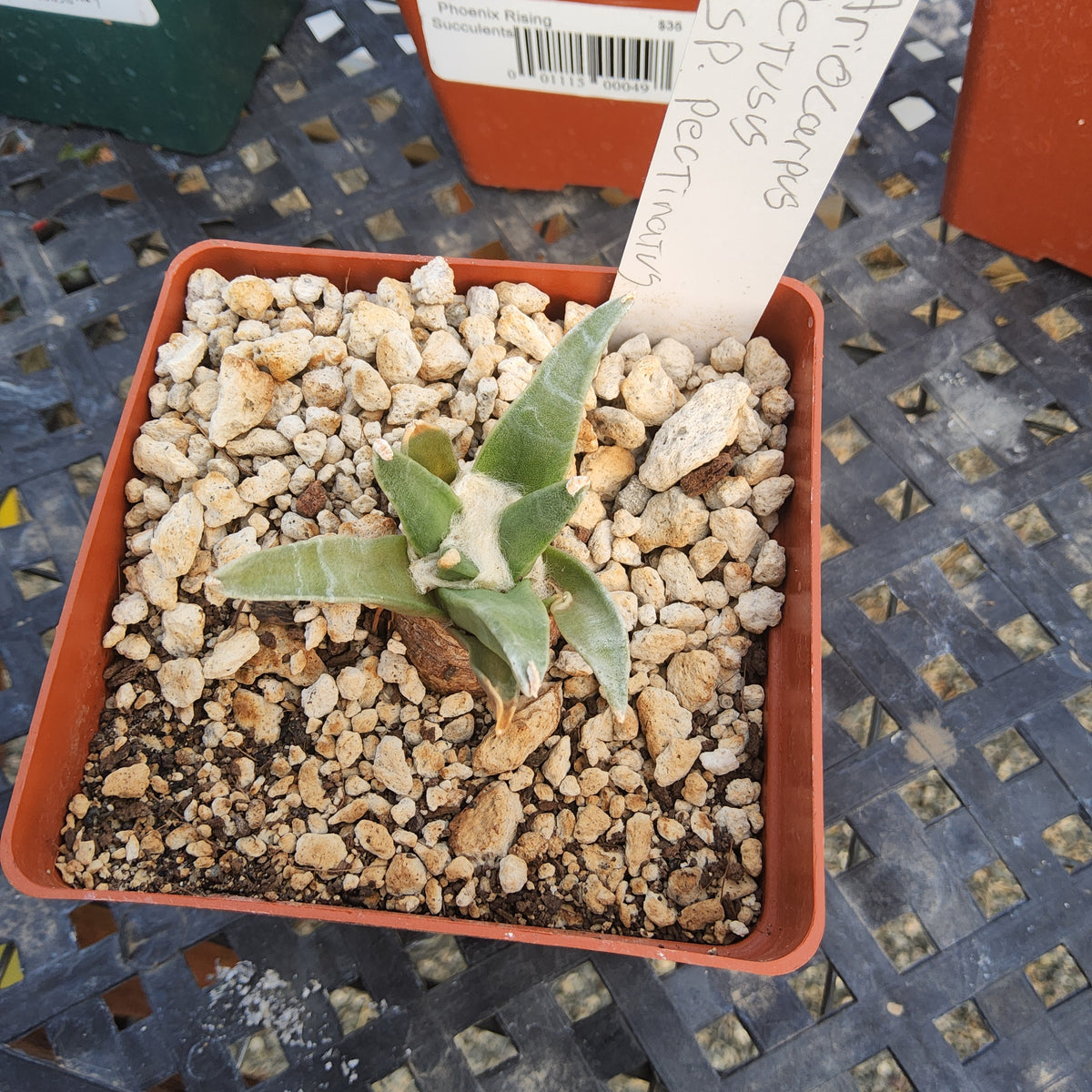
Ariocarpus retusus ssp. pectinatus | Pectinate Living Rock | Mexican Collector Cactus
Ariocarpus retusus ssp. pectinatus | Pectinate Living Rock | Mexican Collector Cactus
Couldn't load pickup availability
Ariocarpus retusus ssp. pectinatus is an unusual collector form of the highly variable Ariocarpus retusus complex, distinguished by its elongated woolly areoles and persistent comb-like, or pectinate, spines. These minute spines begin developing while the plants are still young and remain present with age, although they can become partially hidden beneath the dense areolar wool of mature specimens.
Plants form low, flattened gray-green rosettes approximately 10–15 cm (4–6 inches) across, composed of thick triangular tubercles. The areoles may extend for much of the upper surface of the tubercle and range from approximately 2.5–20 mm long, while the tiny pectinate spines measure only about 1.2–2 mm. This unusual combination gives mature specimens a distinctly woolly, textured appearance unlike typical spineless forms of A. retusus.
Native Habitat:
The precise wild origin of Ariocarpus retusus ssp. pectinatus is unresolved.
The plants used for the original description were raised from seed supplied by Alfred B. Lau in 1971. Those seeds arrived without locality information, labeled only as Ariocarpus retusus var. trigonus. The original author later noted that Lau's field-number list contained a collection under Lau 729 from Huizache, San Luis Potosí, using the same name, and suggested that the pectinatus material may have originated from that population. This connection was never proven.
For that reason, Huizache should be treated as a possible provenance rather than a confirmed type locality.
If the Lau 729 connection is correct, the habitat would fall within the high Chihuahuan Desert around Huizache, San Luis Potosí. Documented Ariocarpus retusus collections from Huizache occur around 1,400–1,700 meters elevation. Field records from the locality document associated cacti including Turbinicarpus klinkerianus, Lophophora williamsii, Thelocactus bicolor, Echinocereus pectinatus, Echinocereus cinerascens, Echinocereus pentalophus, Opuntia imbricata, and Opuntia microdasys. These plants characterize the Huizache cactus community, but they should not be presented as confirmed associates of the original pectinatus seed collection because that provenance remains uncertain.
Flowering Information:
Mature plants flower primarily during autumn, typically around October in cultivation.
One particularly useful feature of the original cultivated lineage is its flower color. Weisbarth reported the flowers as consistently pure white, lacking the pinkish sheen or reddish midstripe that can occur in some other Ariocarpus retusus forms. Flowers are approximately 4–5 cm (1.6–2 inches) across and emerge from the woolly center of the rosette.
Soil Type:
Grow in an exceptionally fast-draining, predominantly mineral substrate consisting of materials such as pumice, coarse limestone gravel, decomposed granite, lava rock, and coarse grit, with only a small proportion of organic matter.
The substantial taproot requires excellent aeration and adequate depth. A deep container is preferable to a shallow pot so the root system can develop naturally.
Water thoroughly during active warm-weather growth and allow the substrate to dry completely before watering again. Reduce watering sharply as temperatures cool and keep plants dry during winter dormancy.
Hardiness:
A practical conservative range is approximately USDA Zones 8b–11 under dry, well draining conditions.
Cultivated Ariocarpus retusus can tolerate brief temperatures around 14°F (-10°C) when completely dry, but this should be treated as an approximate survival limit rather than a routine growing temperature.
As with other Ariocarpus, cold combined with moisture is substantially more dangerous than brief dry frost.
Light Requirements:
Provide bright light to full sun, with some protection from extreme afternoon summer heat in very hot climates.
Strong light promotes compact growth, dense wool, and natural proportions. Plants raised under greenhouse conditions should be gradually acclimated before exposure to intense outdoor sunlight.
Propagation:
Propagation is primarily from seed.
One of the most interesting aspects of the original pectinatus material is that the distinctive pectinate spination proved stable through repeated seed propagation. Weisbarth reported that seedlings maintained the same characteristic appearance through four generations, supporting the interpretation that the trait was genetically stable rather than simply an environmentally induced abnormality.
Grafting can greatly accelerate growth and flowering, but grafted plants frequently become more inflated and less natural in proportion than specimens maintained on their own roots.
Collector's Note:
Ariocarpus retusus ssp. pectinatus was described by Manfred Weisbarth in 2003 in Kakteen und andere Sukkulenten. The material traced back to seed supplied by Alfred B. Lau in 1971, and the designated cultivated type was deposited as ULM 17099.
The name pectinatus refers to the unusual comb-like arrangement of the tiny persistent spines. The original description distinguished the plant from typical A. retusus primarily by its 2.5–20 mm elongated areoles and persistent 1.2–2 mm pectinate spines.
Weisbarth also considered whether the plants might represent a horticultural hybrid. He reported that the pectinate character remained consistent through four generations of seedlings and noted that the flowers remained pure white. He therefore argued that the lineage was stable and unlikely to represent a cross involving A. kotschoubeyanus or A. fissuratus.
The locality history requires particular caution. Lau's original 1971 seed shipment carried no collection locality. Huizache was suggested only later because Lau's field list recorded Lau 729 from Huizache, San Luis Potosí under the same historical identification. The original publication itself placed a question mark after Huizache and explicitly stated that the wild origin could not be established.
Modern taxonomy takes a broad view. Kew's Plants of the World Online places Ariocarpus retusus ssp. pectinatus in synonymy under the accepted Ariocarpus retusus. World Flora Online and the modern Cactaceae checklist go one step further and record the name ssp. pectinatus as nomenclaturally invalid, although it remains widely used in specialist cultivation.
For collectors, pectinatus remains a very useful horticultural designation because its combination of elongated woolly areoles and persistent comb-like spines is immediately recognizable and has remained stable through cultivated generations.
This is for one plant similar to the one shown growing in a 4" inch container shipped bare root. All of our plants are guaranteed pest-free and healthy upon delivery, and we ship within the United States. Shipping is done Monday thru Friday.
Any questions please ask.
#prsucculents
Share