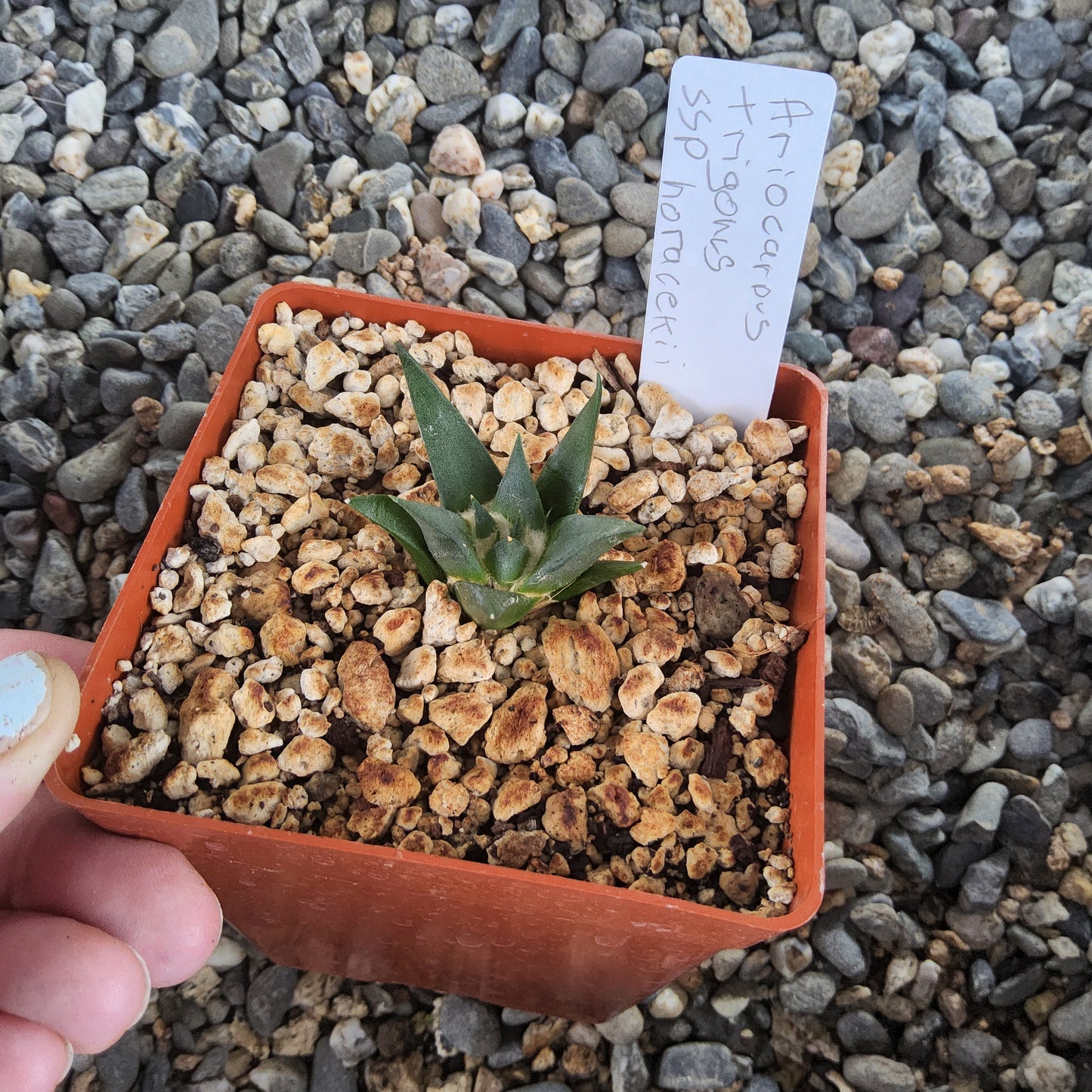
Ariocarpus retusus | Ariocarpus trigonus var. horacekii | Matehuala, San Luis Potosí | Collector Cactus Growing in 4 Inch
Ariocarpus retusus | Ariocarpus trigonus var. horacekii | Matehuala, San Luis Potosí | Collector Cactus Growing in 4 Inch
Couldn't load pickup availability
Ariocarpus trigonus var. horacekii is a compact geographic form from San Luis Potosí, Mexico, traditionally valued by collectors for its smaller stature, strongly pointed tubercles, and elegant pale yellow to creamy flowers. Although historically associated with Ariocarpus trigonus, modern taxonomy places this plant within Ariocarpus retusus, making it an excellent example of the considerable natural variation found throughout the retusus complex.
Plants are typically solitary and grow as low, depressed rosettes of yellow-green to gray-green tubercles. The tubercles are smooth, elongated, sharply pointed, and often strongly incurved, giving mature specimens a distinctly star-like architectural appearance. Compared with typical A. trigonus, plants historically called horacekii are especially noted for their smaller overall body size while retaining the long, triangular tubercles and pale flowers associated with that group.
Native Habitat:
The horacekii population originates from San Luis Potosí, Mexico, particularly the region south of Matehuala. Type information for the later name Ariocarpus retusus ssp. horacekii places the material in the vicinity of Matehuala and Palmas, with the type associated with the field collection P. Panarotto PP851028.
This region lies within the dry interior of northeastern Mexico, where Ariocarpus grows in open desert and dry-shrubland environments. The plants remain low to the ground and rely on a substantial taproot and extremely well-drained mineral soils to endure prolonged drought and strongly seasonal rainfall.
Flowering Information:
Mature plants generally flower during late autumn into early winter, producing satiny cream-white, yellowish-white, or pale yellow flowers, occasionally with reddish midstripes on the outer tepals. Flowers are typically around 3–5 cm (1.2–2 inches) across and emerge from the woolly center of the rosette.
The flowers are hermaphroditic, containing functional stamens and a functional pistil.
Soil Type:
Grow in a highly porous, predominantly mineral substrate consisting of pumice, coarse grit, decomposed granite, fine gravel, and a small proportion of mineral loam or similar material. Excellent drainage is critical, as prolonged moisture around the large root system can quickly lead to rot.
A deep container is strongly recommended to accommodate the substantial taproot. Avoid rich, moisture-retentive soils, particularly during cool weather.
Hardiness:
Best suited to approximately USDA Zones 8–10 when grown outdoors under suitably dry conditions. Established plants can tolerate brief temperatures approaching 14°F (-10°C) when completely dry, but prolonged freezing combined with moisture should be avoided.
A cool, completely dry winter rest is important for maintaining healthy roots and promoting the plant’s naturally compact growth habit.
Light Requirements:
Thrives in bright light to strong filtered sun, with mature, acclimated plants tolerating substantial direct sunlight. Strong light encourages low, compact growth and helps prevent the elevated, overly lush appearance sometimes seen in plants grown under insufficient light.
In very hot climates, some protection from intense afternoon sun is beneficial, particularly for young seedlings and greenhouse-grown plants that have not been gradually acclimated.
Propagation:
Propagation is primarily from seed, which produces the most natural growth form and preserves genetic variation within the population. Seedlings develop slowly and benefit from somewhat gentler light and more consistent moisture during their earliest stages.
Grafting can significantly accelerate growth and flowering, but grafted plants often become taller and more inflated than specimens grown naturally on their own roots. For collectors seeking the characteristic compact form, seed-grown plants on their own roots are preferred.
Collector's Note:
The taxonomic history of horacekii is unusually complicated. Josef Jakob Halda first published the name Ariocarpus trigonus var. horacekii in 1997. The following year, several alternative combinations appeared, including Ariocarpus elongatus ssp. horacekii and Ariocarpus retusus ssp. horacekii. The latter was published by Halda and Panarotto in 1998 using material collected by P. Panarotto under field number PP851028 from the Matehuala–Palmas area of San Luis Potosí. The epithet honors L. Horáček.
Kew's Plants of the World Online currently accepts Ariocarpus retusus as the taxonomic placement for the horacekii names, treating both A. trigonus var. horacekii and A. retusus ssp. horacekii as synonyms. Interestingly, Kew simultaneously recognizes Ariocarpus trigonus itself as a distinct species, native primarily to Tamaulipas and Nuevo León. This means the San Luis Potosí horacekii population is presently considered part of A. retusus rather than A. trigonus under Kew's treatment.
Despite its lack of current formal taxonomic recognition, horacekii remains a useful and well-established collector name for this compact Matehuala-area population, preserving valuable information about its geographic origin and distinctive morphology.
This is for one plant similar to the one shown growing in a 4" inch container shipped bare root. All of our plants are guaranteed pest-free and healthy upon delivery, and we ship within the United States. Shipping is done Monday thru Friday.
Any questions please ask.
#prsucculents
Share