Agave parryi var. truncata | Artichoke Agave | Cold-Hardy Mexican Collector Succulent
Agave parryi var. truncata | Artichoke Agave | Cold-Hardy Mexican Collector Succulent
Couldn't load pickup availability
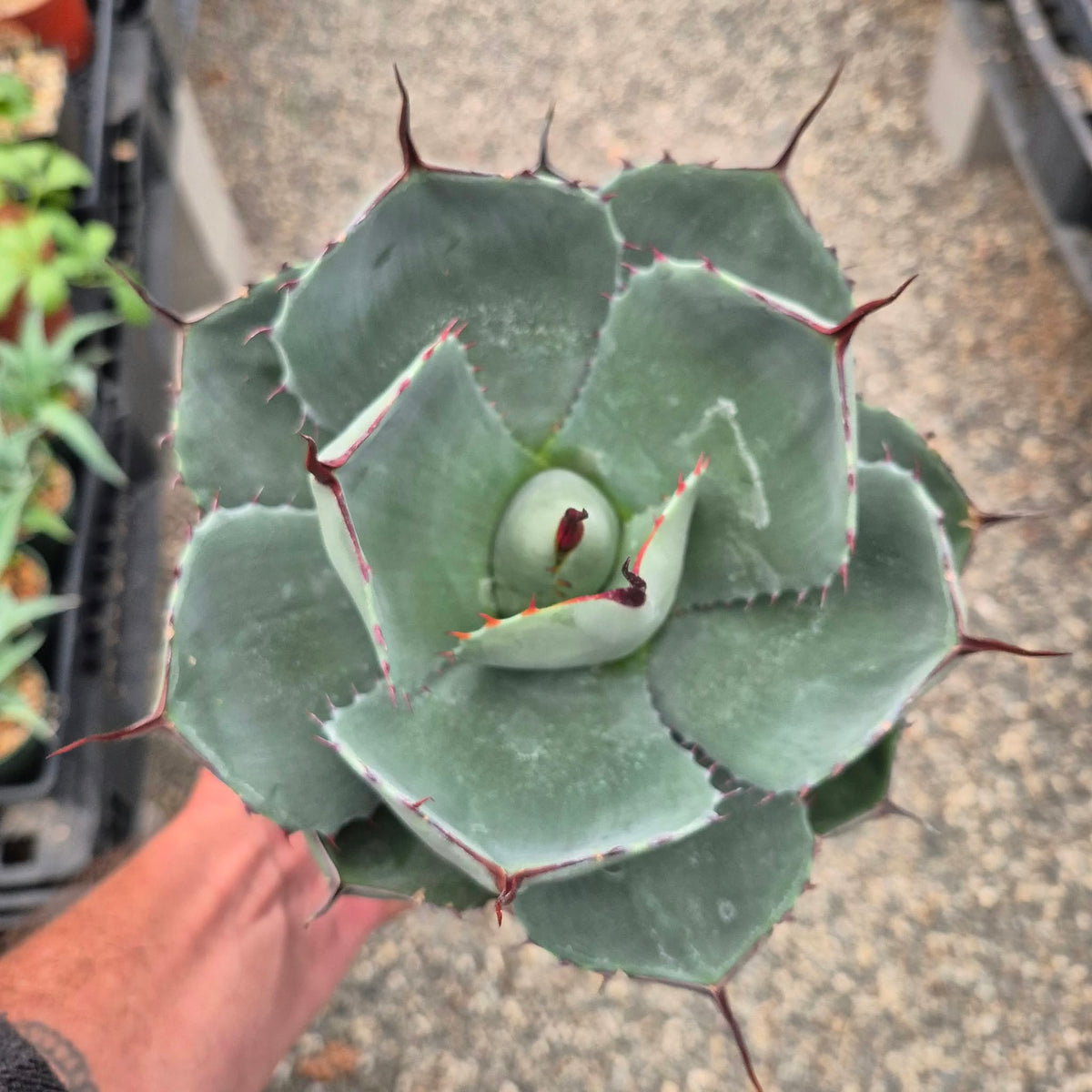
Agave parryi var. truncata, commonly known as the Artichoke Agave, is a compact and exceptionally symmetrical form of Agave parryi distinguished by its broad, shortened blue-gray leaves and tightly arranged rosette. The overlapping leaves create the sculptural, artichoke-like form that gives this variety its common name, with prominent bud imprints adding additional texture to mature specimens.
Leaves are thick, glaucous blue to silvery gray and much broader in proportion to their length than those of many other forms of A. parryi. The margins carry reddish-brown to dark brown teeth, while each leaf terminates in a contrasting dark terminal spine. Individual rosettes are generally compact, although established plants can slowly produce offsets and eventually form impressive colonies.
Native Habitat:
Agave parryi var. truncata is native to northern-central Mexico in the Durango–Zacatecas border region. Kew currently records the native range as Durango and Zacatecas.
The classic type locality is in the Sierra Papantón, approximately 14 miles (22.5 km) west of Sombrerete near the Durango–Zacatecas border. Original Gentry material was collected there on open, rocky, south-facing slopes within oak-juniper grassland. Herbarium records place collections from the locality around 2,250 meters (7,380 feet), while later accounts of the population give elevations around 2,450 meters.
This high-elevation habitat experiences substantial temperature variation, seasonal rainfall, intense sunlight, and genuine winter cold. The plants grow in rocky, rapidly draining terrain among open oak-juniper vegetation rather than in hot low-desert conditions.
The broader Sombrerete highlands also support a diverse xerophytic flora. Regional rocky habitats containing Agave parryi include Agave schidigera, Echinocereus polyacanthus, Mammillaria gummifera, Mammillaria moelleriana, Opuntia robusta, Opuntia durangensis, and Yucca decipiens. These species are documented from the surrounding Sombrerete mountain landscape and should not be interpreted as proof that every one occurs directly beside the Sierra Papantón type population.
Flowering Information:
Like other Agaves, Agave parryi var. truncata is monocarpic. A mature rosette flowers once, after which that rosette dies. Established plants can persist through offsets produced before flowering.
The inflorescence is tall and strongly branched. Particularly noteworthy are the orange to reddish-orange flower buds that open into yellow flowers, producing an attractive bicolored effect unusual among commonly cultivated Agaves. A flowering plant documented from cultivated material originating with the Gentry collection clearly exhibited this orange-bud/yellow-flower combination.
Flowering generally requires many years of growth, and plants should be regarded as long-lived landscape specimens rather than Agaves expected to bloom quickly.
Soil Type:
Grow in a very well-drained, mineral-rich substrate. A mixture containing pumice, lava rock, decomposed granite, coarse gravel, or grit with a modest organic component works well.
Its natural occurrence on open rocky slopes makes drainage especially important. Established plants tolerate drought extremely well, but growth improves with periodic deep watering during warm weather when the soil drains rapidly.
Reduce irrigation substantially during cold winter conditions. Cold combined with prolonged root-zone saturation is considerably more hazardous than dry cold.
Hardiness:
Agave parryi var. truncata is one of the more cold-tolerant ornamental Agaves. A practical conservative range is approximately USDA Zones 7b–10 in well-drained conditions, although cold performance varies among clones and with winter moisture.
Its natural occurrence above approximately 2,000 meters confirms that the variety is adapted to genuine winter cold. Cultivated plants have survived substantial freezing temperatures when established and dry, but leaf damage can occur during severe or prolonged freezes.
In colder climates, sharp drainage and protection from persistent winter moisture are particularly important.
Light Requirements:
Provide full sun to very bright light for the most compact growth and strongest blue-gray coloration.
Plants tolerate some light shade, and in extremely hot inland climates a small amount of afternoon protection may reduce summer stress. Insufficient light can produce a looser, less symmetrical rosette.
Gradually acclimate greenhouse-grown plants before exposing them to intense outdoor sunlight.
Propagation:
Propagation is by seed or vegetative offsets.
Established specimens can produce basal offsets, although var. truncata is often comparatively slow to offset, and some individuals remain solitary for extended periods. Offsets can be separated once adequately rooted.
Seed propagation produces genetically variable plants. This is particularly important with horticulturally selected clones: seedlings may not retain the extremely compact proportions or leaf characteristics of a particular parent specimen.
The historic Huntington material was sufficiently slow to multiply vegetatively and tissue culture was used to increase genuine clonally propagated material from the documented Gentry accession.
Collector's Note:
Agave parryi var. truncata was formally described by Howard Scott Gentry in 1982 in Agaves of Continental North America. Kew's Plants of the World Online currently accepts the variety as Agave parryi var. truncata, native to Durango and Zacatecas. A 2024 combination at subspecies rank, Agave parryi ssp. truncata, is currently treated by Kew as a synonym rather than the accepted name.
The type is based on H. S. Gentry & C. L. Gilly 10566, collected on June 8, 1951 in the Sierra Papantón, approximately 14 miles west of Sombrerete. The original habitat notes describe an open rocky slope with southern exposure in oak-juniper grassland.
That collection has an especially useful horticultural history. Material corresponding to Gentry 10566 was maintained at the Huntington Botanical Gardens as HBG 23389, and genuine clonal material was later distributed through the International Succulent Introductions program. The Huntington described its characteristic combination of broad glaucous leaves, compact artichoke-like rosettes, pronounced bud imprints, and dark terminal spines.
For collectors, the combination of documented Sierra Papantón provenance, compact blue-gray rosettes, substantial cold tolerance, and unusual orange-to-yellow flowering display makes Agave parryi var. truncata one of the most distinctive members of the A. parryi complex.
This is for one plant similar to the one shown shipped bare root. All of our plants are guaranteed pest-free and healthy upon delivery, and we ship within the United States. Shipping is done Monday thru Friday.
Any questions please ask.
#prsucculents
Share