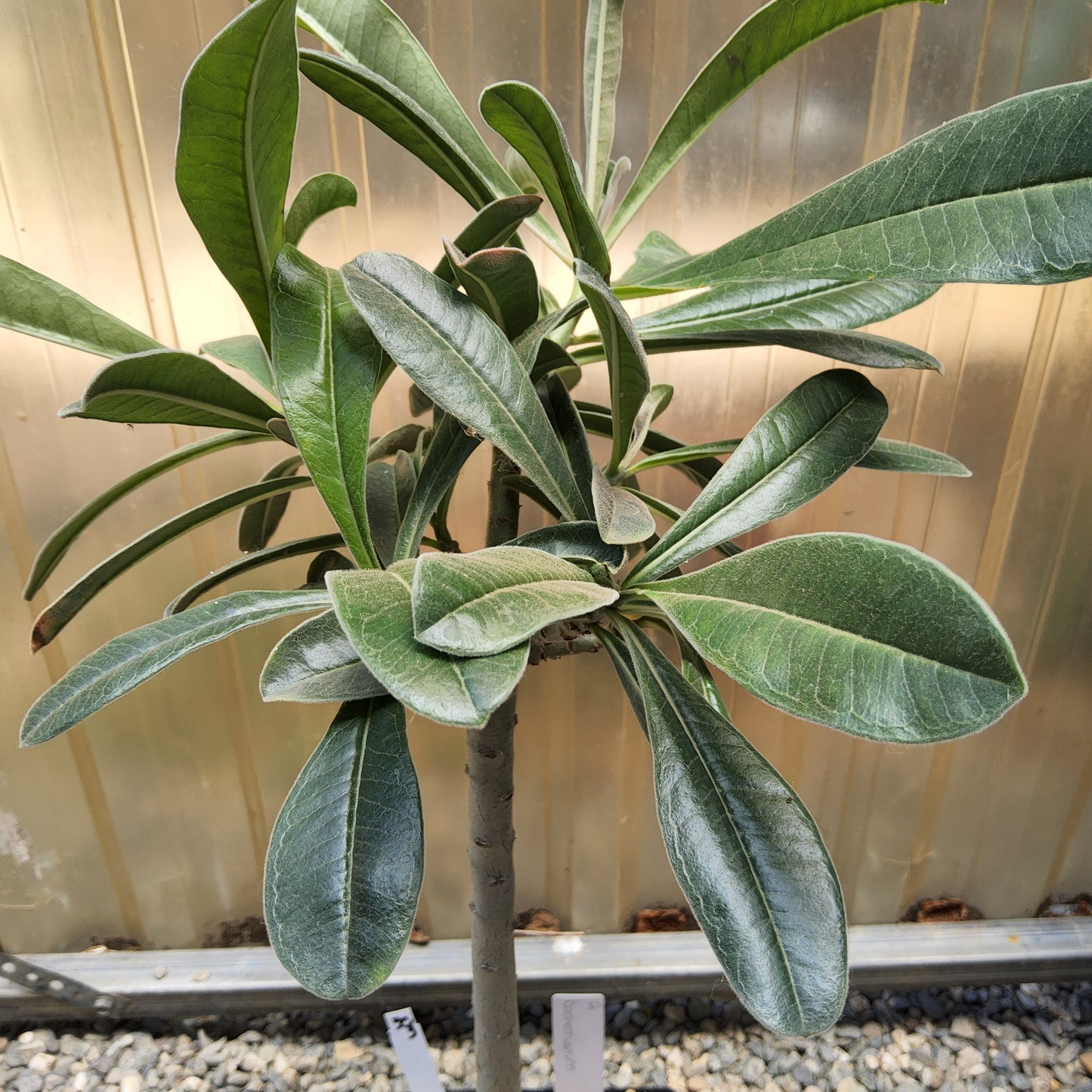
Adenium boehmianum aka Desert Rose Live Succulent Growing in 1 Gallon
Adenium boehmianum aka Desert Rose Live Succulent Growing in 1 Gallon
Couldn't load pickup availability
Adenium obesum ssp. boehmianum is one of the most distinctive and geographically isolated forms of the Desert Rose. Native to the arid landscapes of southwestern Africa, this remarkable caudiciform shrub is prized for its thickened trunk, sculptural branching, and broad, silvery-gray leaves that create a striking architectural presence. During its growing season, mature specimens produce large, funnel-shaped flowers in shades of soft pink to lavender, making this subspecies one of the most elegant members of the Adenium obesum complex.
Unlike many cultivated Desert Roses that have been selected for continuous flowering, Adenium obesum ssp. boehmianum follows the rhythms of its native environment, exhibiting a pronounced seasonal growth cycle with periods of dormancy. Its naturally sculptural form and adaptation to extreme aridity have made it especially desirable among collectors of caudiciform plants.
Native Habitat:
Endemic to northwestern Namibia and adjacent southwestern Angola, where it inhabits the Namib Desert and the transitional Kaokoveld region. It grows on rocky hillsides, granite and gneiss outcrops, gravel plains, and exceptionally well-drained mineral soils at elevations ranging from approximately 300–1,200 meters (980–3,940 feet). This region experiences extremely low annual rainfall, frequent coastal fog, intense sunlight, and significant day-to-night temperature fluctuations. Plants are commonly found growing among sparse desert shrubs and grasses in one of Africa's oldest and most biologically unique desert ecosystems.
Flowering Information:
Mature plants bloom primarily from late spring through summer, producing large, trumpet-shaped flowers in shades of soft pink, lavender-pink, or pale magenta, often with a darker throat. Flowering generally follows the emergence of new foliage and is influenced by seasonal warmth and rainfall. The nectar-rich blooms attract a variety of native insect pollinators.
Soil Type:
Requires an exceptionally fast-draining mineral substrate composed of pumice, coarse sand, crushed granite, gravel, and very little organic matter. Replicating its naturally rocky habitat is essential for healthy root development and long-term success in cultivation.
Hardiness:
USDA Zones 10–12. This subspecies is not frost tolerant and should be protected from temperatures below approximately 40°F (4°C). During winter dormancy, keep the plant warm and nearly dry to prevent root damage.
Light Requirements:
Thrives in full sun, where it develops a compact growth habit, strong caudex development, and abundant flowering. In extremely hot climates, newly established plants may benefit from light afternoon shade until fully acclimated.
Propagation:
Primarily propagated from seed, producing plants that develop the characteristic swollen caudex and natural architecture prized by collectors. While stem cuttings can be rooted, they typically do not develop the prominent caudex that makes seed-grown specimens so desirable.
Collector's Note:
Adenium obesum ssp. boehmianum is regarded as one of the most distinctive members of the Adenium obesum complex due to its restricted distribution, broad gray-green foliage, and remarkable adaptation to the hyper-arid environments of the Namib Desert. Some taxonomic authorities have recognized it as the distinct species Adenium boehmianum, while others, including Royal Botanic Gardens, Kew, currently treat it as Adenium obesum ssp. boehmianum. Regardless of its taxonomic rank, it remains one of the most desirable wild Desert Rose forms, admired for its sculptural beauty, pronounced seasonal dormancy, and extraordinary adaptation to one of the harshest environments on Earth.
This is for one plant similar to the one shown growing in a gallon container shipped bare root. All of our plants are guaranteed pest-free and healthy upon delivery, and we ship within the United States. Shipping is done Monday thru Friday.
These plants are cold sensitive and should be protected from temperatures below 50 F
Any questions please ask.
#prsucculents
Share